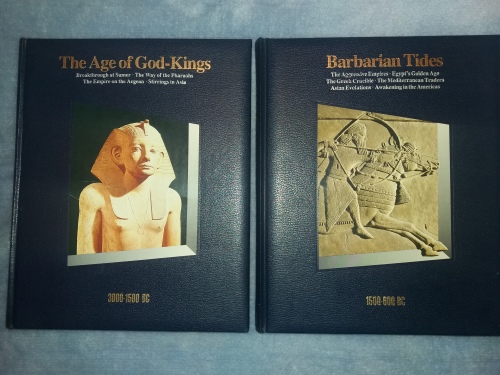
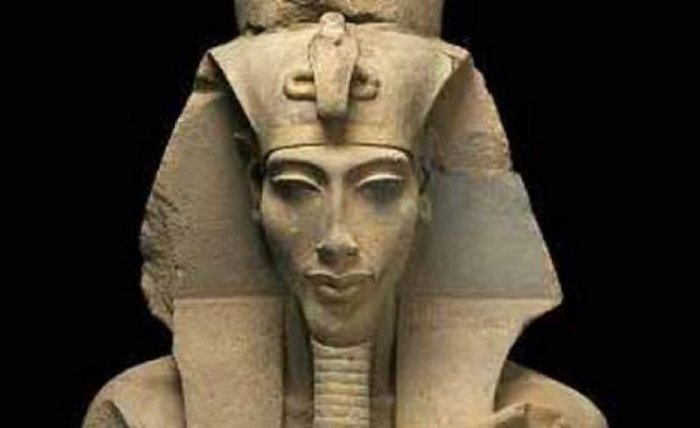
#15 – Empires Ascendant, Time Life BOOK REVIEW

January 31, 2018
krauserpua

I have now answered a question that had bothered me for a while: “how many books could I read and review in one month, if I set my mind to it?”. Most of the projects I undertake are attempts to answer a question that has been bothering me. The rest are normally just assuaging my OCD impulses in compulsive collectathons [1]. So, my reading blitz is over. I’ll continue reading and reviewing but not at such an extreme pace.

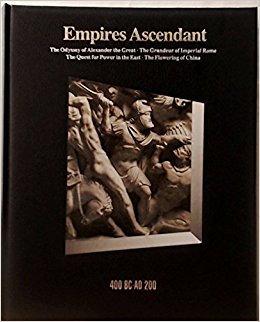
Empires Ascendant

Tony Robbins once said: “For what is a man profited, if he shall gain the whole world, and lose his own soul?” [2]. I think it a very wise statement and I endeavour to live my life in accordance with it [3].

Eckhart Tolle

Tony Robbins, yesterday

Today’s book, Empires Ascendant really brings out the clarity of the statement. It concerns a time when Alexander the Great carved out the world’s largest empire in just eleven years and shortly after when Julius Caesar became Emperor of Rome. Many men struggled and vied for supreme power. And like Queen Cersei says, “in the game of thrones, you win or you die.”

There are certain dogmas in the manosphere that are reflective of equivalent dogmas in the mainstream world. I find they are particularly acute in the USA due to it’s own cultural history (the American Dream, the industrial giants, and so on). There is a certain idea, tangible in the air, in the zeitgeist of what success is.

Money. Power. Girls. Respect. [4]

Dan

Something like this, I imagine

The modern male self-help community is mostly about grasping and striving. The white hats tell you to build you value, the black hats tell you to fake it till you make it. The white hats advise on entrepreneurialism and the black hats tell you to buy crypto-currency or run affiliate programs. They differ in whether you should earn your success or steal it. A worker’s vs a grifter’s mindset. But they both seem to agree on what success is.

Does the dog chasing cars ever wonder what he’ll do if he eventually catches one?

Back in the summer of 2013 I was sitting in a restaurant on Knez Mihailova with he-who-cannot-be-named [5] as we each tucked into a delicious steak washed down with red wine. The sun was shining, beautiful girls sauntered by, and we both had dates lined up for the evening.

“This is it” I said, with a mouthful of beef. “This is living the dream. Just 200 years ago you had to be a prince or an Emperor to eat food like this, travel like this, shag women like this. And now it’s available to any man with gumption.”

It set me off thinking. When Alexander the Great swept through Babylon and towards the Indus river, what was his quality of life like? Was his steak any tastier, his wine any winier, or his bed any more comfortable? It wasn’t just his army crossing the swamps, mountain passes, or rivers – he had to ride his horse Bucephalus over them too.

Shinjuku park

I’ve been, Alexander hasn’t. Do I win?

I kept thinking. Does Bill Gates read better books than me? Does being the richest man in the world give him access to books better than The Count Of Monte Cristo, War And Peace, or Daygame Infinite? No. They all cost just a few pounds [6] It doesn’t buy him better movie-going, or video-gaming, or greener trees or grassier parks. There are extremely harsh diminishing returns to increasing riches. It doesn’t even buy you much better health care, as Steve Jobs found out.

I’ll admit I have occasionally entertained the thought of being an Emperor. Just once or twice. There are certain upsides, such as having a statue of myself on every town square and free run of a harem, but I suspect they’d become boring very quickly. As any common man who has rutted a dozen whores can tell you, having sex with girls who don’t fancy you just isn’t much fun.

Lets say that’s the profit of having gained the whole world. What is the cost?

I remember watching Saddam Hussein get executed. Not literally – I wasn’t there – but there were clips on TV News and the whole thing on LiveLeak. This was a man who held absolute power in Iraq for 24 years. He had a statue in every town square, huge palaces, a fleet of Italian sports cars, lots of concubines, and whatever else he wanted. However, he could barely enjoy it.

I read The Devil’s Double, a memoir by a man who was hired as a bullet-catcher for Saddam’s son Uday, due to the ever present assassination risk. He describes the time he met Saddam. He was held in a room and stripped naked, then searched head to toe including cavities and hair. Then he was dressed in a special outfit, taken to another room, searched again, and then finally met Saddam.

That’s the level of security Saddam lived under. He was playing the game of thrones.

Saddam_Hussein_Execution

Not enough security, evidently

When you’re at that level of power you can’t just book a flight to Belgrade and hit on some birds. You can’t get shitfaced drunk in a strip club and wake up covered in your own vomit on a park bench. You can’t buy a ticket to an FA Cup match of your favourite team. You are trapped by your own power.

Look at how the Mafioso lived as described in Donnie Brasco, flitting away money on strippers because money laundering laws stopped them doing anything useful with it.

Empires Ascendant makes it clear that winning the game of thrones is a Pyrrhic victory [7]. Almost all of the major leaders of the era died young, violently, or both. Here’s a roll call:

  • Phillip II – “as Phillip entered the stadium to preside, a body-guard named Pausanias stepped forwards and ran a sword through the King’s heart” p.19
  • Artaxerxes Ochus – “had been poisoned by his own grand vizier” p.22
  • Darius III – “was murdered by a rebellious Persian satrap, and Alexander went after the killer. He caught up with the man in the wastes of Turkestan, had him flogged and turned him over to a Persian court, which sentenced him to death” p.29
  • Alexander – “while inspecting a drainage project in the Euphrates swamps, he was bitten by an infected mosquito and contracted a [fatal] fever” p.31
  • Roxane [wife] and young Alexander [son] – “were murdered; so were most of the dead king’s other close relatives” p.35
  • Hamilcar Barca (of Carthage) – “during those years Hamilcar Barca died in battle. His son-in-law succeeded him as leader of the Carthaginian forces in Spain, but not long afterwards he was murdered.” p.56
  • Hannibal – “he fled to Syria, then to Bithynia, where he committed suicide by poison in 183 BC just before he was turned over to his enemies” p.58
  • Gracchus – “was campaigning for re-election, he and about 300 of his supporters were set upon and clubbed to death by a huge mob led by senators” p.66
  • Pompey – “escaped and fled to Egypt… It is said Caesar wept when Ptolemy later handed him his old ally’s severed head” p.73
  • Julius Caesar – “60 senatorial conspirators fell upon him as he presided over the assembly, inflicting 23 dagger wounds.” p.73
  • Cicero – “his head and hands were displayed nailed to the Rostra in the Forum he had so often graced with his eloquence; a nail had been driven through the orator’s tongue” p.75

Mark Antony committed suicide by stabbing himself in the stomach, Caligula was murdered by his guard, Claudius was poisoned by his wife Agrippina who was herself murdered by her son Nero. Nero committed suicide when his guard turned against him. His immediate three successors all died in the same year, two murdered one arkancided suicide. Titus was stabbed to death by a servant.

Phew! That’s a lot of short-lived runs at the top, is it not? Augustus, Tiberius, Vespasian are among the few who lived into old age and died peacefully. Generally speaking, the shelf-stacker at Tesco who rents a comfortable flat and has Netflix will live a longer and happier life than most of the above tyrants and kings.

Back in 2013 I came to the conclusion that high level success is not a goal worth chasing. Reason one is that it’s wildly unlikely that you’ll succeed and thus you waste precious years on a failed project. Reason two is that even if you do succeed, the rewards probably aren’t worth it, because the best things in life are fairly cheap. Reason three, is even if somehow you dodge those landmines you are faced with the central problem addressed by Zen philosophy – the material accoutrements and phantasms of ego aren’t actually satisfying anyway. You’re just chasing chimeras.

And lastly, if you somehow become incredibly successful and powerful you’ve just lost all of your freedom – which in itself is more valuable than all the palaces, sports cars and hookers put together.

If you thought that was a long-winded rationalisation for myself being very comfortable with exactly where I am right now, you may be onto something and would definitely enjoy Daygame Infinite.

[1] It’s why I like Ubisoft games.
[2] Okay, technically it was Matthew 16:26 in the King James Bible but I’m sure we can all agree that it’s not wisdom unless an internet marketer self-help guru says it.
[3] Another good one is “victors write the history books”. Those five words are a rabbit hole all of their own, the degree to which I even now struggle to comprehend.
[4] Dan Bilzerian, basically.
[5] “my mate from Wales”
[6] Except the last one. You get what you pay for.
[7] Page 53 also told me what that is, “one more such victory over the Romans,” Pyrrhus supposedly said, “and we are utterly undone.”

#14 – The Italian Secretary, Caleb Carr BOOK REVIEW

January 31, 2018
krauserpua

I bought a multi-volume hardback special collection of Robert E. Howard’s Weird Tales some years ago. Each volume had an editor’s introduction and one in particular stuck with me. He was commenting how many literary sorts would poo-poo Howard’s prose style as being unsophisticated. In Howard’s defence, the editor said (and I paraphrase): You can either tell a story or you can’t. If you can, the reader will forgive you all your literary errors. If you can’t, no amount of literary polish will bring him onto your side. Howard tells a great story [1]

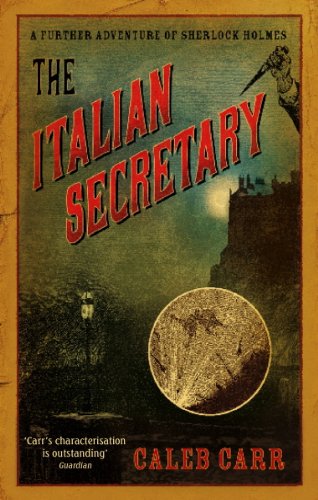
Italian Secretary

Caleb Carr, in this book at least, can’t tell a good story. I’m shocked at how inept it is because, in contrast, the prose is polished. Carr isn’t a buffoon, he’s just a terrible storyteller.

This book made me angry. Actually angry. That is most unlike me as I tend to be extremely charitable to writers, respecting anyone who puts forth the effort to write a decent book. I don’t demand talent or excellence every time out. Just a decent effort and a little ability. If this book had been subtitled, “A further adventure of Laszlo Kreizler” [2] I’d have accommodated myself to his position. I’d attempt to understand what world view he was attempting to represent, what his characters’ actions show about themselves, and I’d let him unfurl the plot at his own pace and with his own preferred machinations.

Thing is, this is actually subtitled “A further adventure of Sherlock Holmes.”

It was marketed as being in the Holmesiverse, and I handed over my £12.99 [3] and committed my seven hours reading time upon that promise. I know who Holmes and Watson are, how their stories progress, and what to expect. This book betrayed that, and I’m angry because I can’t have those hours back.

Holmes and watson

Was this too much to ask?

For the first thirty or so pages it appeared promising as his prose style imitates the vocabulary and verbosity of Conan Doyle’s Watson but then it all starts to fall apart. I began to realise he’d misconstrued Watson’s style. In the original short stories Watson gets to the point quite quickly. Although his verbiage is a little flowery and his sentences often indirect and full of sub-clauses, he is nonetheless always talking about something that moves us forwards. He doesn’t just prattle on. Watson of this book prattles on.

“This book is a short story stretched into a novel” I concluded. Hardly anything was happening but page after page of waffle overwhelmed me. It was an effort not to begin skimming pages until something happened [4]

David Mamet released a writer’s masterclass last year, which I recommend as highly as the Aaron Sorkin one, and he constantly impresses the point that a novel should throw out everything that isn’t advancing the plot.

“You are going from New York to Baltimore. That’s your plot. You don’t stop off at Boston just because it looks pretty. Get to Baltimore.” [paraphrase]

David Mammet Masterclass

Great writer, BJJ player, and a Jew. I’m conflicted

He goes on to discuss ‘location sickness’ in the movie and television business. Let’s imagine the script calls for filming a scene of some cheerleaders outside a high school. You roll up at the school location and notice there’s a really cool shoe shop across the road where the building is in the shape of a shoe.

“Wouldn’t it be cool to fit that into the movie?” asks a location manager.

No! It’s not part of the plot. You’ll kill the movie by trying to put every little interesting thing into it. Stick to the script.

I was reminded of this while reading The Italian Secretary. It is loaded with pointless details and diversions, going into the history of an old murder in the time of Mary Queen of Scots or really obvious red herring such as political intrigue in Germany. At least half of this book has no reason to be there and it builds reader resentment in being slowed down. It’s a feeling akin to the helicopter rides in Metal Gear Solid 5: offensively pointless padding.

I also watched a YouTube interview with schlock horror writer Guy N. Smith in which the interviewer asked about his fast-paced writing style. Again, I paraphrase (heavily):

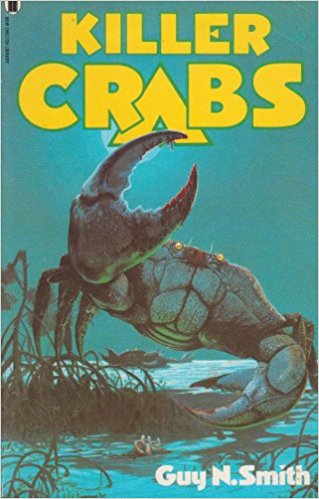
“I don’t see the point of detailed descriptions” he said. “If your scene is: he strode out of the door, picked up a shovel, and struck a heavy shot to the giant crab’s pincers then that’s what you write. Nobody wants to know if the door is teak, oak or mahogany. We don’t need to know it’s two metres high or two inches thick. Or if the door knob is polished brass with scratches and rust. Just have your hero stride out of it and hit the bloody crab.”

Killer Crabs

Can you tell a story?

Here’s an example from Carr’s book, where Holmes, Watson and a servant creep into a castle tower at night:

“There was no ambient light of any kind: The window shutters in each of the rooms – starting with the antechamber, into which the stone staircase disgorged us – had been closed and fixed generations earlier, and far more efficiently than in the rooms immediately below. They had been covered with much heavier curtains, such that we continued to see solely by the light of Hackett’s relatively small torch: although what we saw was, in truth, far less important than what we felt. The basic appointments of the chamber – panelled walls and ceilings, wooden floors, rotted textiles, decrepit furnishings – were proportionally more unnverving than those below, the more so for being Tudor rather than baroque in style. And yet, as I inspected the appointments further, it occurred to me that there is, in houses, a certain moment at which decay seems to slow dramatically, so long as the building’s walls and roof remain intact (as was the case with the palace’s west tower); indeed, the process of decrepitude seems at some point almost to stop, as though not only Time, but vermin of every variety, have taken all they can take and destroyed all they can destroy, leaving behind what amounts to the bleached bones of a formerly warm, living habitation. And Queen Mary’s rooms had, apparently, long ago reaches this archaeological nadir.” [p. 198-199]

Admit it, you started skimming didn’t you? I’d rewrite it as follows:

“Closed shutters and heavy curtains created an oppressive darkness. Hackett guided us with his small torch through a chamber thick with musty air and decrepit furnishings in the Tudor style.”

It takes Carr fully three pages to convey the action of walking up a staircase and reaching the Queen’s old room. It should’ve taken one paragraph. This is painfully slow writing made all the worse that it’s utterly boring and none of the added details does anything to add richness to the scene, the characters, or the plot. It’s junk.

Bad writing aside, this book also suffers from being nothing like an actual Sherlock Holmes story. If the characters weren’t called by the same names as Conan Doyle’s men, you’d never guess. I’ll outline the key plot events, and ask yourself “is this how a real Holmes story plays out?” [spoilers]

  • An architect is murdered in the grounds of Holyroodhouse while conducting renovations to an old tower. Two weeks later a builder is also murdered. Both are stabbed many times.
  • Holmes and Watson take a special train to Edinburgh following a needlessly cryptic note from Mycroft. This is ostensibly due to the espionage red herring, but it becomes clear Mycroft didn’t much suspect espionage so a simple note would’ve been more likely.
  • The train is held up by an explosion, then a red-bearded Scottish nationalist throws a bomb into the carriage. It turns out this was a blind. The “nationalist” was attempting to distract from the real motive, and the bomb wouldn’t go off. It’s never explained how he knew the train was coming (evidently the note wasn’t sufficiently cryptic) and when it’s later revealed to have nothing to do with espionage, it makes even less sense. If Mycroft really did fear espionage enough to send a cryptic note, he wouldn’t have tipped off the guy who turned out to be the bomb thrower in disguise. A plot hole.
  • Holmes never once inspects a crime scene. Wow.
  • Holmes recognises the facial structure of the house groundsman as being the same as the train bomb thrower, thus solving the murder within ten minutes of arrival on page 102 of a 275 page book. The rest of the time he’s just filling in the blanks without telling us or Watson.
  • It’s never explained why the two victims were stabbed many times, or why all their bones were broken. Initially it’s presented as a puzzle, but it never becomes relevant in figuring out the murderer’s identity, means, or motive.
  • Holmes discovers that two local men are running secret mystery tours of the tower in which Queen Mary’s Italian secretary was brutally murdered. Literally, tourism. This runs many years without anyone finding out (!) and makes so much money that they fill an entire mattress in the tower with gold sovereigns.
  • They just leave the sovereigns there. Because Carr needs them to in order to set up the finale.
  • They murdered the two men because they were about to stumble upon the secret tours. Yes, this entire book centres around tour guides taking tourists into a tower for thrills. Moriarty it isn’t.
  • Some dappy servant wench is hiding in the tower, pregnant with the child of one of the tour guides. She just tells Holmes who he is and about the tours. Holmes doesn’t actually deduce anything.
  • Rather than confiscate the sovereigns or arrest the men, they instead lie in wait near the tower for the murderers to break in and take their sovereigns. It’s never explained why the murderers will do it tonight. Or at all. Or why they never emptied the mattress months or years ago.
  • Rather than remove all sources of confusion, Holmes leaves the frantic pregnant girl hanging around. Later she falls off the top of the tower in a dramatic scene that had no reason to happen.
  • One of the two tour guides is a good guy, so he marries this tart who his brother got up the duff. It’s never a modern Sherlock story without some cuck being cucked somewhere in the plot.
  • The murderer’s great strategy to sneak in and get their money back is to….. build a medieval trebuchet and launch the fiery body of a murdered policeman at the castle wall, then set a bomb off at the gates. Naturally, Holmes and Watson immediately run to the site of the diversion and leave unguarded the one place which they knew the murderers had to go.
  • The main bad guy sets himself on fire by accident, without Holmes or Watson having contributed. The other bad guy escapes and is caught by police at a port, again with no input from Holmes or Watson (and not even as a scene, it’s just reported later).

It’s staggering how bad this book is. Holmes and Watson do basically nothing useful throughout. The only deduction is Holmes recognising the face of a man he meets, a couple of hours after the same man stared right into his face but had a red beard. You master detective you! He doesn’t even do anything with that deduction. He finds out about the plot because they stumble into a girl who tells them the full story. They then completely fuck up their stakeout, nearly get the girl killed, and only catch the killers because one of them is kind enough to set himself on fire and the other runs into a police cordon. Watson does nothing except bloviate.

Horrible, horrible book.

If you’d prefer a story featuring real heroes who accomplish fantastic deeds through wit, charm and good-old-fashioned pluck, then you’ll love my memoir Balls Deep, A Deplorable Cad, and Adventure Sex.

[1] His prose style is also under-rated because he’s high-t and action-heavy, which modern readers hate progressively more as their t-count gets progressively lower.
[2] The Holmes-a-like sleuth Carr invented in his earlier books.
[3] Or would have, if I hadn’t found it on a market stall for a few quid. But that’s not the point!
[4] The afterword explains that it was in fact commissioned as a short story and then turned into a novel. Bad move! A novel needs different pacing, more sub-plots, and more plot development. A short story can be hung upon a single idea or gimmick.

#13 – The Bolshevik Myth, Alexander Berkman BOOK REVIEW

January 29, 2018
krauserpua

You’d be forgiven for thinking I’ve lost interest in Daygame, but no. This is simply Project High Value Man limping it’s way to the finishing line in month one. I’ve had this book on my shelf since my second year in university but never got round to reading it. Wish I had, as it would’ve ended my experiment with Leftism a few years earlier. What’s fascinating is throughout his time describing Moscow, Kiev and Odessa I have actually walked many of the same streets as he did.

Berkman Bolshevik Myth

My parents are Leftists. My mother is a low-information champagne socialist who hasn’t studied a single page of socialist theory or real world history in her life. That doesn’t stop her from routinely saying “I wish someone would shoot him” while watching the BBC trashing Donald Trump. My dad is less retarded and less hateful, our conversations going like this:

Me: Trump is draining the swamp. Today, [say something fact-based from an actual event currently hitting, such as Devin Nunes giving an interview on #ReleaseTheMemo]
Dad: *shakes head dismissively* No Chance.
Me: What don’t you like about Trump?
Dad: I don’t like him.
Me: What is it don’t you like? What policy of his do you oppose?
Dad: I just don’t like him.

My father prefers the ostrich’s head-in-the-sand approach. Usually I let it pass, but once in a while I’m a little exasperated and I’ll say what I really think, such as:

“Dad, you’re just hoping you can make it to the grave without ever suffering the humiliation of knowing your world view is completely wrong and that you’ve always voted for the maximum evil every chance you cast a ballot.”

Harsh, I guess.

My parents are living in a carefully-constructed delusion bubble and I frequently see the anxiety in their eyes when reality presses too close. They have restricted their information about the outside world to just two sources, the Bolshevik British Broadcasting Corporation and The Grauniad Guardian. Their response to reality is to hide from it and double down on their self-inflicted gas-lighting.

“Dad, you’re like a battered wife. Every single time the BBC and Guardian lie to you, I tell you in advance of the lie. I prove it to be a lie. You still dismiss it. Then within a week I’m proven right and what do you do? Run right back to the people lying to you.”

Harsh, I know.

It is from dealing with my parents, and from spending several years around fringe Far Left politics as a teenager [1] that I’ve come to understand Leftism as a mental illness rather than a political ideology. There are two types of Leftist:

  1. Lenin’s “useful idiots”. My parents and most of the Far Left foot soldiers fall into this category [2]. They are low-information, easily swayed by emotional and overly-simplified appeals, and completely oblivious to human psychology.
  2. Alinksy‘s “radicals”. These are the self-aware organisers and political fixers, like Cuffy Miegs in Ayn Rand’s Atlas Shrugged. They know Leftism is bullshit but understand it’s utility for giving themselves power. These people are truly evil. See also: Hillary Clinton.

I include this long preamble because Alexander Berkman is a high-functioning useful idiot and The Bolshevik Myth is the story of him getting raped by reality. He began in high hopes:

“Without exaggeration I may say that the happiest day of my existence was passed in a prison cell – the day when the first news of the October Revolution and the victory of the Bolsheviki reached me in the Atlanta Federal Penitentiary. The night of my dungeon was illumined by the glory of the great dream coming true.” [page 327]

This quote is from his post-facto analysis in which he’s thoroughly disillusioned and yet can’t quite give up on the Leftist dream. He’s seen exactly what terrors it creates, how utterly hypocritical its radicals are, and yet he still believes it was simply socialism done wrong. He devotes the last chapter (“Anti Climax”, not in the original edition) to a theoretical analysis of where it went wrong and, precise though it is, he just can’t let go of his commitment to Leftism.

It’s Leftism that is wrong. It’s fundamentally broken. This is because at its very centre it is built on theft, which requires totalitarianism, which then requires lies. This has never – in the entire history of Leftism – been proven wrong. Every single time, Leftism begins with theft, proceeds to totalitarianism, and is covered in lies. Berkman remained a battered wife to his grave, lamenting that socialism just needed one more chance.

Few people today grasp how evil the Alinsky Left is. Not ‘mistaken’ or ‘deluded’ but outright evil. Those people would do well to read Orwell’s Animal Farm as it draws out the tragedy of the Bolshevik revolution. However, although Orwell is biting in his satire and perceptive in his observation of trends, his book is ultimately about pigs, sheep and wolves. If you read Berkman’s The Bolshevik Myth you get an unvarnished account in human form. This is real-life starvation, corruption, mass murder, and ideological fanaticism. It’s in your face, horrifically bleak, and 342 pages of data points collected from first hand experience of how evil the Left is.

The book begins with the author’s deportation form the USA just before Christmas 1919. Interestingly, Alexander Berkman is a Leftist Jew himself. Exactly the sort of person who should’ve been deported. Just look at this biography from the introduction (by a sympathetic editor):

Fucking Jews

And people wonder where the reputation comes from….

Every. Damn. Time.


This review is not, however, about how you should never allow Jewish intellectuals into your country [3]. It’s simply to set up the key theme of this book: disillusionment. Berkman is as Left as they come and a lifetime agitator for Anarchism. He was extremely excited to be sent to Russian a year after the revolution because he wanted to help the revolution. This book is written by a man absolutely sympathetic to the cause of the Russian Revolution. The book then describes the most harrowing experience a Leftist can ever suffer: reality.

Ayn Rand was inspired to write Atlas Shrugged because of the same period in Russian history, which she too experienced first-hand before escaping to the USA. From 1919 to 1921 was a period of utter incompetence from the Bolsheviks. She makes a great deal in Atlas Shrugged of how most deprivation and tragedy occurs not due to sneering evil-doers actively hurting people but instead due to the utter incompetence of the Left once in charge. Many of them sincerely believe running an economy is easy. You just have to kick the capitalists out, tell everyone to work hard, and then decide where the products go [4]. Ludwig von Mises absolutely destroyed this argument in his book Socialism, written in 1922, and in particular with what he terms the ‘problem of economic calculation’.

Mises

Can someone give me the cliff notes?

As is clear from Berkman’s book, we didn’t need to wait for Mises. Back in 1919 everyone in Russia knew exactly what the problems were. It’s just the Bolsheviks were too busy murdering and betraying everyone for it to be stopped.

I’ve long believed that the only difference between the actions of SJWs now and the Tcheka in 1920 Russia is opportunity. The psychology is exactly the same. These are self-serving narcissistic personalities with hair-trigger amygdala. Total hyprocrites. Capitalism rewards the kind of people who effectively deal with reality. The Bolsheviks created a system that perfectly selects for dangerous murderous hypocrites and then encourages them to get even worse. Berkman’s book is very long on the examples. That SJW reporting you to Facebook and conducting a whispering campaign behind your back is the Commissar who would have you summarily executed without trial for ‘speculation’ if it was 1920’s Russia. Same people. Vermin. Evil.

Berkman presents a world of utter chaos and a population too tired from starvation and terror to do anything about it. He arrives in Petrograd when the White army is still fighting the Reds, and the Mahknovists in Southern Ukraine are still taking territory. The West has an economic blockade on and my oh my do the Bolsheviks make use of that as an excuse.

The narcissist never accepts responsibility for his failures. Berkman shows us this throughout his examples. At a high level, the problem is “the blockade” or “the speculators” or “the counter-revolutionaries”. It’s never ever the Bolshevik policy. At a street level the chaos is always blamed on somebody else. Commissars and functionaries spend most of the day shirking responsibility [5]

At times I felt like I was reading a Sven Hassel novel.

Hassel wrote a pseudo-memoir of his time fighting in a German penal battalion on the Eastern Front in WWII. His books are full of chaos. Commissars and SS officers barge into villages and press-gang conscripts for suicide missions. There is an ever-present fear on both sides of the military police because they are constantly arresting people on trumped up charges and executing them without trial. Quartermasters steal the foot solider’s stores so the infantry are left bartering secretly with peasants to survive. Political fanatics rant and rage, looking for people to abuse, always blaming their own errors on everyone else. Caught in the middle of it all is the oppressed masses, waiting for the madness to end.

The whole time I read these Hassel books I thought, this is a bit overly-dramatic. It’s not very believable.

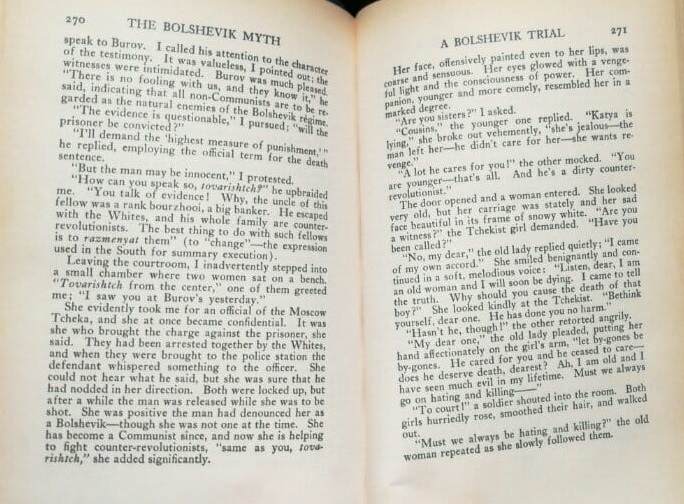
Bolshevik trial

This could easily be a scene from a Sven Hassel novel, or modern US university campus

Berkman’s book reads just like Hassel, without the battle scenes. The Bolsheviks really were that crazy, that incompetent, that fanatical, and that evil. They betrayed everyone who ever helped them. Just like Vox Day describes SJWs as following the ever-changing narrative like a school of fish changing direction, Berkman depicts the Bolsheviks as shifting alliances on pure expedience. Evil people.

We are left with a country in the grip of madness. A hell on earth. The Bolsheviks take control of a city and murder the opposition. They install themselves as leaders and steal everything ‘for the people’. They then set impossible targets for production but make the bureaucracy so unwieldy that no-one can even get a permit to work. The factories are idle so they need to blame somebody and shoot some workers. Then they raid the markets and imprison or shoot some local traders, the very people keeping the population alive. By now the peasants have had everything stolen so they aren’t planting the food needed to keep the cities alive. So the Bolsheviks shoot the peasants.

It’s a horror show but…. if you’ve ever watched the Left run organisations nowadays in the West, you’ll see they do exactly the same thing, limited only by their lack of power and access to guns. The Left always eats its own.

Trotsky

Just another mass murderer worshipped by the Left

I’ve said before that it’s always Year Zero with the Left. There’s a reason Orwell said: “The past was alterable. The past never had been altered. Oceania was at war with Eastasia. Oceania had always been at war with Eastasia.” Everything the Alinsky Left touches they destroy. They are pure evil. The only way they can keep singing their ruinous siren song to the next generation of useful idiots is by airbrushing and falsifying the history of what they did last time. [6]

I read an illuminating book by Anthony Flew when I was at university, called Thinking About Thinking. In it, he introduced the logical “No True Scotsman” fallacy. It goes like this:

Imagine Hamish McDonald, a Scotsman, sitting down with his Glasgow Morning Herald and seeing an article about how the “Brighton Sex Maniac Strikes Again”. Hamish is shocked and declares that “No Scotsman would do such a thing”. The next day he sits down to read his Glasgow Morning Herald again; and, this time, finds an article about an Aberdeen man whose brutal actions make the Brighton sex maniac seem almost gentlemanly. This fact shows that Hamish was wrong in his opinion, but is he going to admit this? Not likely. This time he says: “No true Scotsman would do such a thing”.

We can make the logical structure of the fallacy clearer by changing the topic from murder to porridge, and from Hamish to Angus

If Angus, a Glaswegian, who puts sugar on his porridge, is proposed as a counter-example to the claim “No Scotsman puts sugar on his porridge”, the ‘No true Scotsman’ fallacy would run as follows:

(1) Angus puts sugar on his porridge.
(2) No (true) Scotsman puts sugar on his porridge.
Therefore:
(3) Angus is not a (true) Scotsman.
Therefore:
(4) Angus is not a counter-example to the claim that no Scotsman puts sugar on his porridge.

Rab C Nesbitt

A true Scotsman, yesterday

If Bolshevism, a socialism, is a criminal racket of theft, murder, torture and lies, is proposed as a counter-example to the claim “Socialism is the highest expression of human society”, the “No true Socialist” fallacy would run as follows:

(1) Bolsheviks are evil thieves and murderers.
(2) No (true) socialist is an evil thief and murderer.
Therefore:
(3) Bolshevism is not (true) socialism.

This is why no amount of examples, in China, Venezuela, Cuba and so on, will ever persuade a Leftist that socialism is evil. No amount of predictive and accurate economic and social analysis (i.e. Mises) will persuade them. No amount of Democrats getting caught red-handed trying to build a Bolshevik state, or of Labour flooding the country with third world savages will ever persuade them.

War is Peace. Diversity is Strength. Refugees are Welcome.
Four legs good, two legs bad. No human is illegal.

Berkman’s book is fascinating not just because of the powerful critique it lays against socialism but also because of the degree of self-delusion as Berkman simply cannot leave the partner who is beating him. He can’t escape the gas-lighting and keeps doubling down on his No True Socialist fallacy until finally he collapsed and died. It’s sad too, because this book positively drips in Berkman’s essential humanity. He’s a fundamentally good guy who desperately wants what is best for the people and puts himself at personal risk repeatedly to alleviate what suffering he can. He’s in anguish at the sufferings the Bolsheviks subject the Russian people to. [7]

Naturally, the idealist loses and Cuffy Miegs wins.

NKVD

The Workers Paradise, yesterday

If you think I’m smart and write intelligently about smart stuff, you’ll fucking love Daygame Infinite. It’s proper smart. Or, if you are curious about how the Former Soviet Union is now, post-Bolshevik, for clacking tarts then you’ll like my memoir Adventure Sex. It’s in the same place as The Bolshevik Myth but there’s waaaaaay more shagging.

[1] And watching Monty Python’s Life Of Brian
[2] As did I until about my mid-twenties. It takes a long time to shake off the narcissistic abuse of living in The People’s Republic Of Northern Britain.
[3] I might do a post on that later. Almost every ideology or administrative act to destroy Europe and the USA has a Jewish intellectual behind it somewhere.
[4] Nothing has changed on the Left since because they never ever learn from history.
[5] And the other half feathering their nests with stolen goods. The 1920s equivalent of Patreon accounts and Government jobs, basically.
[6] It’s no surprise that people who adhere to an ideology based on lies would also be shameless liars themselves. Look at how many times Hillary Clinton has been caught at it and yet her supporters simply don’t care. They all embrace the lie.
[7] Even though he’s a Jew. There are several chapters which are the usual Jewish belly-aching where they are apparently the worst victims. Sigh…. don’t care

#12 – Where Are The Customers’ Yachts? Fred Schwed Jnr BOOK REVIEW

January 28, 2018
krauserpua

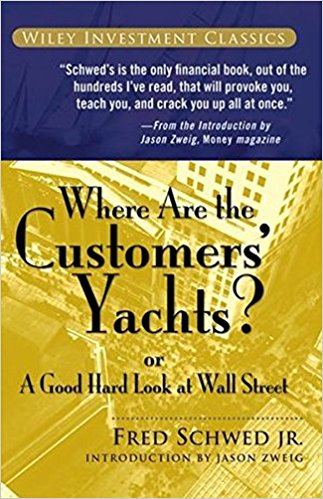
There is an apocryphal story of a summer day in 1870 when friends of a major short-seller, William R. Travers, got together by the shores of Newport, Rhode Island. They were admiring the enormous yachts of Wall Street’s richest brokers. After gazing long and thoughtfully at the beautiful boats, the short-seller asked wryly,

“Where are the customers’ yachts?”

The obvious implication is that the brokers get rich off the backs of their customers, and thus Wall Street is a scam [1]. This would lead you, as it did me, to expect Schwed’s book to be an indignant diatribe on the evil of Wall Street [2] but it’s nothing of the sort. This book is about farce. The central theme Schwed pushes throughout Where Are The Customers’ Yachts?, written in 1940, is that the “masters of the universe” [3] are deluded buffoons tilting at windmills. Some get rich, most don’t, but all of them are scrabbling around thinking they’ll make it big and it’s pure luck who succeeds and who goes broke.

Where are the customers yachts

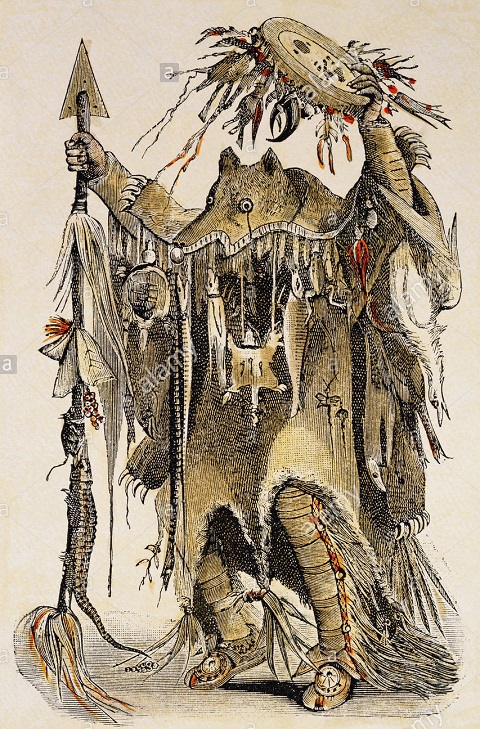
I worked in Finance. I spoke to a lot of brokers, traders, hedge fund managers, mutual managers, compliance officers, salesmen and so on. Although many were very smart and very sincere men, I came away thinking they were indeed deluded. There is no there there. They may as well be divining financial performance from animal entrails [4]. Here’s an example, where Schwed talks of chartists – a fringe element who now call themselves “technical analysts” and “swing traders”.

“There have always been a considerable number of pathetic people who busy themselves examining the last thousand numbers which have appeared on a roulette wheel in search of some repeating pattern. Sadly enough, they have usually found it.

I once suggested to a chart reader, who was explaining his theories to me, that since I wasn’t a customer he should slip me a wink. It was a social error; he was as deeply offended as if I had said something gross about his religion – which, I suppose, I had.

A busted chart reader, however, is never apologetic about his method – he is, if anything, more enthusiastic than the solvent devotee you may run across. If you have the bad taste to ask him how it happens that he is broke, he tells you quite ingenuously that he made the all too human error of not believing his own charts.” [page 37-39, excerpts]

Note the tone of Schwed’s language. He isn’t reaching any theoretical consideration on the merits or demerits of the chartist approach. He’s instead making a (facetious) factual reference that the chartists he knows personally are all broke and that their thinking is more like the religious fanatic than the dispassionate investor. He’s interested in the psychology. He’s explicitly stating that the chartist is sincere in his folly. He’s a fool, not a crook.

All that remains of my interest in financial markets is the psychology of them. It’s pretty obvious that the entire system of financial expertise is hopelessly bankrupt both morally and intellectually. This became particularly clear to me when workmates were studying for their Chartered Financial Analyst (CFA) exams. These are brutally-tough three-year exams which are a level above those who’ve already passed their Chartered Accountant exams [5]. My team were very smart young people with solid maths and lots of experience of the investment business and they all struggled to pass the CFA and spent the whole time stressed out. They’d use their annual holiday just for study and revision time. I stayed well away.

The thing is, the syllabus of the CFA is all bullshit. It’s an attempt to “do a Friedman” [6] on investment theory. It’s all built upon spurious assumptions, fake economics, and the conclusions don’t pass the smell test. Just look into the Capital Asset Pricing Model if you want to disappear down the pseudo-science rabbit hole [7].

Schwed isn’t interested in why something like the CFA is bullshit, because that’s theory. He just wants to note two things, (i) it’s of no help in making successful investments, and (ii) the people who believe in it have the psychology of deluded fools.

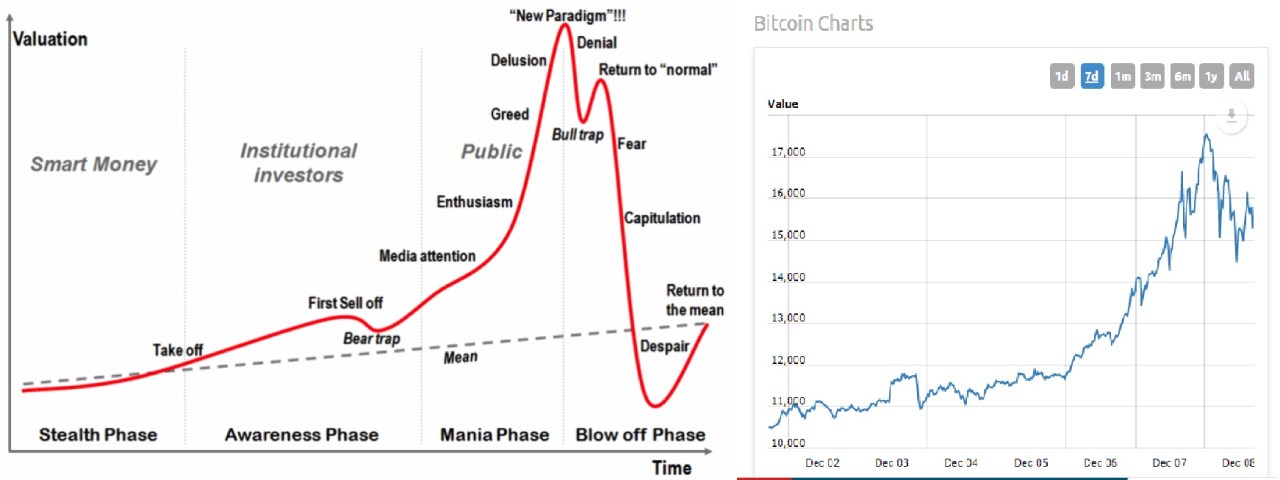
Financial Bubbles

A total utter coincidence, yesterday

Most of Where Are The Customers’ Yachts? is a survey of the different participants in financial markets. So there is a chapter on financiers and seers, one on customers, one on investment trusts, one on short-sellers, and so on. Schwed considers them all fools who are easily-led and financial products little different to the wicker baskets passed around in insane asylums

Doctor to patient in room one: “Here’s some wicker, make a basket. It’s good for your inner calm and will keep you busy.”

[one week later takes completed basket from patient]

Doctor to patient in room two: “Here’s a basket. Unravel it. It’s good for your inner calm and will keep you busy.”

Even if, somehow, there was a legitimate scientific basis to financial investment [8] you still couldn’t predict it because of PvP. In video games there are two basic forms of play: Player vs Player, and Player vs Environment. In the latter you master a skill and then beat the levels. The levels themselves remain the same so your progression in the game lies in better handling the static challenge they throw at you [9]. This is how you can go from being rubbish at Super Mario 3 to speed-running it in a snip under 51 minutes. Watch some “no hit” playthroughs of Dark Souls and Bloodborne for how much skill these people have.

Everything changes when there’s another player who has a theory of mind. Now everyone is second-guessing everyone else. Most interesting things in the world are PvP not PvE. This holds in sport too: the 100m sprint is PvE, as is most track and field, whereas the interesting sports are all PvP [10].

Financial markets are PvP.

Schwed also goes into detail about the problem of hiring expertise. He only lightly covers the agent-principal problem, that you hire someone for help you and they instead use the opportunity to help themselves [11]. Schwed is more interested in conundrums and psychology. Here is a lengthy example:

“Let us have 400,000 men (and women) engage in this contest at one time. We line them up, facing each other in pairs, across a refectory table miles long. Each player is going to play the persons facing him in a series of games, the game chosen being a matter of pure luck, say matching coins.

The referee gives a signal for the first game and 400,000 coins flash in the sun as they are tossed. The scorers make their tabulations, and discover that 200,000 people are winners and 200,000 are losers. Then the second game is played. Of the original 200,000 winners, about half of them win again. We now have about 100,000 who have won two games and an equal number who have been so unfortunate as to lose both games. The rest have so far broken even.

[by the fifth game] these 12,500 have now won five straight without a loss and are no doubt beginning to fancy themselves as coin flippers. They feel they have an “instinct” for it. However, in the sixth game, 6250 of them are disappointed and amazed to find they that they have finally lost, and perhaps some of them start a Congressional investigation.

[by the ninth game] this little band [of a 1000] has won some nine straight without a loss, and by this time most of them have at least a local reputation for their ability. People come from some distance to consult them about their method of calling heads and tails, and they modestly give explanations of how they have acheived their success [12]. Eventually there are about a dozen men who have won every single time for about fifteen games. These are regarded as the experts, the greatest coin flippers in history, the men who never lose, and they have their biographies written” [pages 126-127]

Surely no-one is so stupid as to believe this, you may say. Well, go have a look at the marketing literature of mutual funds. Look at the league tables where each fund manager is sorted into quartiles and, if they are first quartile, they loudly trumpet it in the literature. They are telling you they won the last few coin tosses.

Schwed does hold out the theoretical possibility that performance is more than simply luck but he laments that no-one has ever been able to explain to him what that theory is.

Crypto cunt.jpg

“There is strong support at £6k but the candlestick pattern suggests a double bottom and possible resistance at £7k”

If you liked this post, you’ll probably urge me to explain my thoughts on the recent speculative mania in crypto currency and how neatly it fits in to both Schwed’s opinion on chartists and Time Life’s on ancient shamans and diviners. It’s all about the psychology. Till then, buy Daygame Infinite. It’ll make you rich [13]

[1] No surprise it’s a short-seller who said this. Their role is to pop the bubbles of financial markets and the entirety of government, regulation, and popular mood is lined up against them. Nobody likes the child who mentions the Emperor has no clothes.
[2] And thus, likely, Jews too.
[3] As they were called in the 1980s in the time of Gordon Gecko, before Charlie Sheen had AIDS.
[4] The parallels with shamans and seers in the Time Life history of the ancient world is fun. There appears to be very little difference between them and the Wall Street shamans and seers.
[5] I guess you’d call it the Daygame Infinite to the ACA’s Daygame Mastery.
[6] Milton Friedman tried desperately to cloak the pseudo-science of Economics in the clothing of Physics by drowning it all in equations, graphs, theorems and other some such. It was an abject failure. You might as well do the same with dog-petting or poetry-recital and call those sciences.
[7] For as long as economists misunderstand what money is, they’ll get economics wrong. So long as they misunderstand human psychology, they’ll get economic prediction wrong.
[8] There is, but it’s very simple and experts can’t charge high fees for it. The value of an asset is the net present value of all future cash flows. The skill in investment is to accurately predict those cash flows and then apply a suitable discount % rate to them. The difference in those judgements of two inputs explains the whole difference in valuations of an asset. Note value and price are not the same thing – price can be influenced by other factors.
[9] Artificial intelligence will shift the dynamic into PvP if it’s good enough, in that it simulates a player who can adapt to your strategies. If the AI can’t, it’s still PvE.
[10] The acid test for PvE is “would my strategy change if my rivals change theirs?”. The 100m sprint is eight PvE races running side-by-side. No matter what the other seven people do, your strategy always remains “cover the 100m distance in the quickest possible time”.
[11] This is a huge problem in Wall Street but he doesn’t cover it because it comes under the “crook” province which is outside of his scope. A great example is how all the major broker-dealers like Lehman, Merryl, Morgan, and Bear switched from partnerships to public companies and immediately the managers began a “bankruptcy for profit” model to gouge the new owners.
[12] I don’t remember where I heard it, but I like this sentiment: “when I hear investors giving advice on how to get rich, I’m reminded of last week’s lottery winner explaining how he chose his numbers.”
[13] Nick, where are all your customers’ yachts? I’m asked.

#11 – A Soaring Spirit, Time Life BOOK REVIEW

January 25, 2018
krauserpua

Right this is a big one. I came to the cafe with my laptop fully intending to play SimCity (the new one that everyone hated but I like) and then I just got carried away with writing. I’m quite used to limiting myself in what I’ll say on the blog in order to keep it all about Game. I thought I’d relax those rules further for at least this post. Let me know if you think that’s a good or bad idea.

I’d always thought the Persians were cunts. Except the women, obviously, who are well hot. But as a general rule, they seemed like a right bunch of twats. I may have been mistaken.

Back when I used to daygame the London streets I spoke to quite a few Iranian girls, usually in or around Selfridges department store. Their thick black hair, dark eyes, and strong features would really attract my interest [1]. I noticed that when I did the usual LDM stack and commented they looked Middle-Eastern, they’d always describe themselves as Persian, and not Iranian. In contrast, men always seemed to say Iranian [2].

Persian girl

I’ve never had a problem with this kind of immigration

Ten years ago, my knowledge of Iran/Persia was limited to the following:

  • They murdered a female police officer then held hostages in the London embassy. Our SAS smashed them, big time.
  • The Ayatollah put a fatwa on a smug annoying novelist who, so photos seem to show, has pretty good game.
  • Saddam Hussein took US/UK support to pick a fight with them in the 1980s, leading to the Iran/Iraq war. At one point Iran responded by emptying it’s insane asylums and marching the patients through minefields to clear them.
  • In the 1998 World Cup they beat the USA in a football match with a crazy amount of heat on it.
  • In 1985 they received weapons from the US, via Israel, in contravention of sanctions and the cash they paid went to fund anti-communist guerrillas in Nicaragua.

So, I was hardly a subject-matter expert on the region. And, except for the hotness of their girls, there didn’t really seem to be any point to the country existing. Recently, I’ve been taking a keener interest in them because of the sweeping world revolution that Donald J Trump has instigated, with the help of Crown Prince Mohammed Bin Salman.

Now, what I’m about to lay out here is based on one part evidence and three parts conjecture. It is completely against the dominant media / scholarly narrative. Subsequent events may prove it to be incorrect and I’ll thus look a bit foolish [3]. However, today, on the 25th January 2018, this is what I know about Iran/Persia……. or think I know.

Trump Salman

Cover of Time Life #20 – “The Saviours Of Western Civilisation”

Contrary to the impression you’d get from walking around the East End of London, any part of Germany, or from watching LiveLeak, Muslims are not all jihadi cunts. It just seems like that because the jihadi element is very vocal, very well funded, and their collaborators are installed at high levels in Western governments, NGOs, media, and of course certain Mayors.

sadiqkhan

Time Life #21 – “Jihadi Infiltrators Who Were Executed For Treason”

Most Muslims are as half-assed about Islam as most Christians are about Christianity. Only a small proportion have ever read the Koran and, like most Christians, most Muslims rely upon professional preachers to tell them what it says and how to interpret it. I know from my own experience of banging Uzbek girls [4] that they have no discernible interest in a theocracy, much less the global jihad. They were rather more interested in fashion, chocolate, and whether I was willing to date them monogamously.

So, how come the jihad has so much funding? How come the third great wave of Islamic expansionism is blighting Europe? Well….. because of this guy.

Pursuing Saudi Prince Alwaleed Bin Talal At London's High Court

A real-life Bond villain

This is Al-Waleed bin Talal and he is the central hub of global jihad. He’s a Saudi and over there it’s like Game Of Thrones. The Saudi Royal family is nothing like the British Royal family [5] who are mostly ceremonial. The Saudis have a huge family and they all wield real political, financial, and administrative power. They are organised loosely into two factions: jihad, and secular. Talal leads the jihadi faction and they’ve been ascendant most of the past thirty years. They funded Al Qaeda, shipped their militants to Syria, funded the mosques and madrasas in Europe, spied and blackmailed politicians, and of course did 9/11.

Naturally they couldn’t do this without support in the West. So Talal funded the Bush dynasty and 20% of Hillary Clinton’s campaign. He put Barack Hussein Obama through Harvard before traitor Barry had even gotten into politics, and he got very tight with George Soros.

With Obama as POTUS and Hillary as Secretary of State things got complex. Obama is no fan of Saudi Arabia but loves Iran, as did the real president Valerie Jarrett, an Iranian national [6]. So whereas the Hillary/Bush cartel was in SA’s pocket, the Obama interlopers were not due to the Iran connection. Hillary just wants $$$ and power, happily selling her office to whoever pays into the Clinton Foundation. Obama is more ideological, he wanted to destroy the USA.

These conflicts came to a head with the Uranium One deal. Putin had zero respect for the Obama/Hillary clown show but never expected it to end, so his job was to make deals good for Russia and for enriching himself. He had a front company under Russian control buy 20% of the USA’s weapon’s grade uranium, but that required the CIFUS board (representatives of the US government’s agencies) to authorise it. Russia paid Bill Clinton for speeches in Moscow and sent $146m to the Clinton Foundation, then Hillary approved the uranium sale. It was shipped through Canada under Justin Trudeau’s nose [7].

There was a problem, though. Obama was being set up.

That uranium found it’s way to Iran, because in the Middle East there are two key power blocks. There’s the Sunni-based alliance of Saudi-Qatar-Emirates-Israel and there’s the Shia-based alliance of Iran-Syria-Turkey-Russia [8]. Russia gave that uranium to Iran to help them get nuclear weapons. Saudi Arabia would not be amused.

Sad obama

“Fuck”

Poor foolish traitorous Obama was caught between a rock and a hard place. The Iran deal – the only thing he did in his second term – was the result. It was nothing more than the Iranian mullahs blackmailing Obama, and Barry trying hard to prevent evidence of his treachery coming out.

Up until two years ago, that was the West fucked. The richest country in the world funding our destruction and all our treacherous politicians on board. Iranian mullahs holding the US administration to ransom in order to get nukes. Then two men stepped up: Donald J Trump and Mohammed Bin Salman.

Salman is the leader of the secular faction in Saudi Arabia. He wants them to be a normal country, not a vipers nest creating global chaos and jihad. Luckily for the world, his faction became ascendant. He began cutting the strings of the jihadis and their Western puppets. And it was definitely in the Saudi national interest.

You see, Saudia Arabia has oil. And nothing else. They need oil at $80 a barrel just to balance the budget. Salman knows this. He knows he’s ruling what would be, without oil revenue, a one-camel town. For a long time it didn’t matter. The Saudis had bought off the Western governments and ensured they passed all manner of environmental regulations to prevent the West ever tapping it’s energy reserves.

Did you really think the Paris climate accords had anything to do with the environment?

Saudi Arabia has had one very strong foreign policy goal for decades: prevent the USA becoming energy independent. The moment the USA stops buying Saudi oil is the moment the whole house of cards Saud falls. Back to being a one-camel town. That’s why Hillary wanted to put Pennsylvanian coal miners out of work and why she opposed fracking, oil shale, and Arctic fields. She was paid to keep the USA dependent on Saudi oil.

Hillary

“But why am I not twenty points ahead?”

With Trump coming in Salman saw the writing on the wall. Saudi Arabia faced a choice: continue with oil dependency and slowly sink into oblivion, or diversify the economy by buying up assets at the moment of their peak wealth. He chose the latter. The very first foreign state visit Trump did as president was to Saudi Arabia. Salman laid out his plan to de-jihadify the Middle East and Trump agreed to support him.

Everything going on in the Middle East now comes from that. SA, via the Gulf Cooperation Council, has elite teams of expensively-equipped commandos annihilating the jihadis. Iranian mullahs are in the cross hairs. So, what has been happening lately:

  • ISIS and Assad routed in Syria. Russia declared victory and left.
  • Iranian-backed Houthis annihilated in Yemen.
  • Hezbollah (the Iranian-run irregulars) routed in Lebanon.
  • Hezbollah drug cartel financiers in South America assassinated.

Between them, Trump and Salman have cut off ALL the money – both official and black. The Mullahs are broke and they spunked away their troops in Syria. Trump even suckered them into massing in the Golan Heights (with his Jerusalem embassy ruse) so that they’d be elsewhere when the GCC kicked off the Iranian protests against the Mullahs.

Have you wondered why Antifa haven’t done anything since Salman arrested the Talal faction? Why has the migrant crisis suddenly slowed down? Salman is a critical part of The Storm. The globalist cabal who almost took over the USA has had it’s funding sources cut off. The Democrat party has lost it’s small-donation base [9]. For a long time, the Democrats have relied on the following funding: (i) Saudi jihadis (ii) Hollywood pedophiles (iii) Globalist billionaires (iv) embezzlement of tax-payer funds [10].

The Storm is cutting off all that money.

the storm

So, let’s bring this round to Iran. Right now there is an attempt at regime change in Iran in which the Iranian people free themselves of the Mullah’s Islamist yoke. Up until 1979, Iran was a ‘secular’ Muslim country, in that it wasn’t a theocracy. The primary victims of the 1979 revolution were the Iranian people. For 40 years they’ve been run by a corrupt gang of criminals who’ve worked to alienate their country from the whole world. They’ve had enough, and the GCC and Trump are quietly helping them.

When the Mullahs are thrown out, expect considerable calm in the Middle East. Expect a significant downturn in the jihad. The two major sources of jihad – the Mullahs, and Talal’s faction – will be neutralised. Saudi Arabia and Iran will become, per Salman’s wishes, normal countries.

A Soaring Spirit

Spirits soaring yesterday, too

So how does this related to volume three of the Time Life history of the world? Well, history doesn’t repeat but it does rhyme. There was a time when Persia was a big deal. If all you’ve watched is 300 and it’s sequel [11] you’d be forgiven for thinking the Persian Empire was on a par with Mordor for size, slaughter, and evil. They were the devils and Europe was at risk of being swamped by the brown horde.

Sounds familiar.

From reading A Soaring Spirit I see that 300 is not a historically accurate movie [12]. The brief history of the Persian Empire is this:

  • Cyrus The Great is a bad ass who conquers Media, Lydia and Babylonia to establish the empire. He is far from a brutal dictator (by the standards of the time). He shows considerable mercy in victory, allows subjugated lands to retain their social order, and rules primarily through adminstrative convenience and mutually-beneficial outcomes.
  • Cyrus dies and his son Cambyses takes power. He is a total cunt and runs the empire like the brutal Assyrians. He doesn’t last long. I suspect he’s Talal’s role model.
  • Darius I takes the throne and extends the empire right through to India. It’s a golden era and like Cyrus he runs it more like a Commonwealth. Persepolis becomes fantastically rich but the tide raises all boats in the Empire. Darius would be the Salman of his day. Mind you, he did have a go at Greece but they smashed him at Marathon.
  • Darius dies and Xerxes takes over, and he’s a total cunt. This is the lisping faggot from the 300 movie. He has a go at Greece but the Athenians and Spartans rout him in several key battles at Salamis and Platae. He returns to Persia to suck the dicks of his faggy mates, probably. Fifty years later assassinations and intrigue have put the empire on the brink of collapse.

So what is my learning point in all this?

Most people, most of the time, act more or less the same (in aggregate). Most just want to be left alone and will remain this way unless stirred up by expansionist leaders, or through the age old formula of Diversity + Proximity = War. The difference between the brutal Persian empire of Xerxes and the administrative empire of Darius wasn’t because the nature of Persian people suddenly changed. It was instead their leadership, and the tone of the times. The Persian people of 1980 were no more of a problem that the Persian people of 1978, but the Mullah’s seizure of power was.

It’s easy to take a Clash Of Civilisations view of how Europe and the Middle East constantly bump up against each other. It’s worth remembering that there have only been three great Muslim attacks on Europe in two thousand years, and all three were significantly due to having warlike scumbag leaders take power. If Trump and Salman are successful, we are about to enter a period of significantly reduced tensions. A period of soaring spirits.

Without the Mullahs or Jihadis to rouse the rabble, they won’t be roused. Without Leftist traitors in government, the West will turn away from “invade the world, invite the world”.

If you are reading this in early 2018, you probably think I’m crazy. If you are reading this in 2019 you think I’m either a total genius, or a total buffoon, depending upon how events unfolded. Let’s see which turns out to be the case. Either way, buy Daygame Infinite.

If you want to know my sources for the analysis of current affairs, I strongly recommend the following:

Dystopia USA – The easiest entry point to understanding The Storm and, so far as I know, the first guy to predict it in detail (at a time it seemed like a crazy conspiracy theory)
The Conservative Treehouse – Extreme detail and breaking news/analysis of The Storm (he calls it The Big Ugly) in how Trump is taking down the USA Deep State. This guy deserves a Pulitzer. True journalism. If you’re new, try Dystopia first because TCTH details will probably get you lost in the weeds.
Thomas Wictor – Amazing Twitter feed for perceptive and minute analysis of Middle Eastern politics and warfighting. I absolutely recommend his tweet storms, especially unrolled. Don’t be put off by his cranky humour and frequently irreverant replies. When he tweet storms, it’s deadly serious. Stunning perception and eye for incongrous details.
Stealth Jeff / Imperator Rex – Excellent tweet storms breaking down FBI/DOJ corruption and how The Storm is routing the black hats.

[1] Serbs and Armenians look pretty close to this too, which is probably why I like them so much.
[2] Which I found out in the wrestling / MMA world, not from daygame.
[3] I did warn you about this in my previous book review.
[4] Three, so far. Not expecting to ever increase that number although I’d quite like to.
[5] Except that several of them are paedophiles and visit Jeffrey Epstein’s lolita island.
[6] Obama was cherry-picked at an early age by the Chicago machine to be an empty suit run by Valerie Jarrett and sold to foreign governments hostile the the USA. Jarrett made most of Obama’s decisions for him.
[7] Another globalist empty-suit working with the Saudis.
[8] Think of the Middle East like the English summer weather: mostly Sunni but sometimes Shi’te. But now it’s Sunni side up.
[9] Hillary was able to rig the nomination against Bernie because she literally bought the DNC, such was their financial straits. Donna Brazille’s book explores this in details.
[10] For example the CFPB, a government-run protection racket to extort fines out of businesses and give the loot to Leftist activists. Needless to say, Trump is shutting it down and Elizabeth Warren is in big big trouble over it.
[11] Admittedly, it’s fucking awesome. I was initially meant to be cast in the role of Leonidas but the producer said that to keep it realistic, they’d then have to rename it ONE.
[12] No shit.


#10 – Strike For Death, John Creasey BOOK REVIEW

January 25, 2018
krauserpua

Who would have thought I’d lose interest in video games? At the time of writing I just finished my 11th book of the year, in less than four weeks. I don’t normally read so fast but this little winter project of mine must be speaking to something deep in my core because all I want to do is read new books. I haven’t touched Assassins Creed Origins in nearly a week, and that’s odd. My guess is momentum for Project High Value Man has been building up quietly and now I’ve settled myself into a comfy chair next to my bookcase, it’s keeping me there. Interesting.

Regular readers have likely observed that I’m not a fan of bandwagon jumping, nor of downloading my thoughts from the internet, media, or academia. When that Jordan Peterson interview went viral I did indeed watch it. What I didn’t do was immediately put up a click-bait YouTube video about it. Just as I never posted a video about how Conor MacGregor might win his superfarce superfight with Floyd Mayweather. Like most red-blooded males, I had an idea how the fight would go but I also found it distasteful to hop aboard the bandwagon.

It’s what women do. And the lower classes.

It’s declasse.

snobs

“Did you see that Stefan Molyneaux response video to the Peterson interview, Jeeves?”


While I’d like to believe I’m some kind of free-thinking iconoclast, I suspect the reality is simply that my personality type is contrarian and I will instinctively act against what I perceive is the herd instinct [1]. The downside of this is I fail to ride trends and my marketing reach is considerably lower than it could be. The upside is also that I fail to ride trends. So I knew not to get involved in the speculative mania of crypto currency [2] or follow the latest game-nonsense-of-the-month [3]

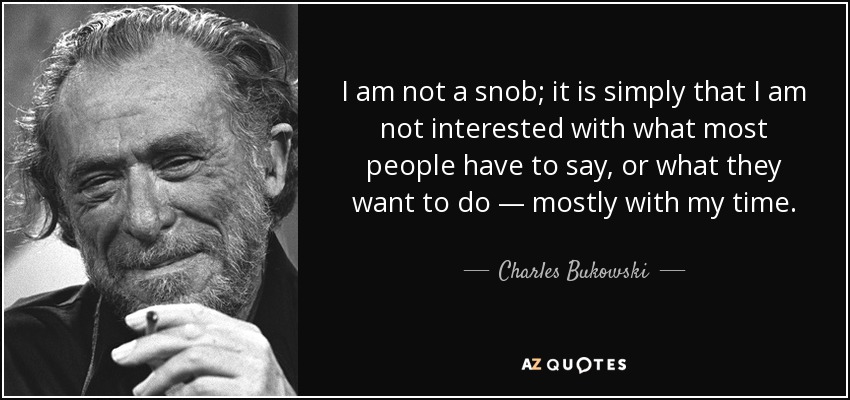
My unwillingness to listen to my betters [4] means that from an early age I reached my own determinations of what is or is not the case and would hold to that no matter what the ‘public mind’ was. Sometimes I’d be spectacularly wrong and embarrass myself but mostly it meant I could see things way in advance while everyone else is running around like fools [5]. If you think this is a good thing, you’d called it ‘being sigma’.

Bukowski

What has that got to do with reading books?

Simply put, I judge books on their merits as I see them rather than what I’m supposed to believe. I don’t read book reviews in the magazines, I treat reputation as the loosest of preliminary guides, and I don’t buy a book just because it’s advertised on the London Underground and Metro newspaper tells me everyone is reading it [6]. This has led me to a (mildly) controversial conclusion about fiction:

The best writers are usually in genre fiction, not prize-winning literature

Genre writers need to tell a story. They need to sell books. To do that, they must grip you in the first few pages and maintain dramatic momentum to the end. You have to finish the book thinking “I want to read more of his stuff”. In contrast, literature writers are mostly trying to get invited to the right parties, full of dull-witted chattering classes who don’t actually read their books [7]. When I was a teenager and I found literature boring, I figured I simply wasn’t savvy enough to appreciate it. Now I’m older, I realise much of it is just the Emperor’s new clothes.

This brings me to John Creasey.

creasey

Here’s one I wrote last week…

I greatly admire this man primarily because he was so prolific. He wrote six hundred novels under twenty-eight different pseudonyms over forty-three years. That’s averaging over one novel a month, consistently. It’s quite staggering really. Most absurdly prolific artists are just rubbish [8] but I’ve read ten or more Creasey books and they are good. You’d never guess they were rushed.

I’m always impressed by men who can maintain a prolific output without suffering a drop in quality. That’s talent and professionalism. It inspires me to work harder. I see no reason to adopt the archetype of a writer popular in the public imagination as a man who patiently and slowly labours over every word and rewrites chapters many times until finally, ten years later, his lone novel is published. Nope, that’s bollocks. Rarely are such books any better than the one-month-turnaround genre fiction. Why?

Because prolific writing is its own apprenticeship. People learn by doing. They learn by getting busy, putting skin in the game, and then reflecting on the lessons that reality has taught them [9]. Anyway, let’s turn our minds to this book in particular.

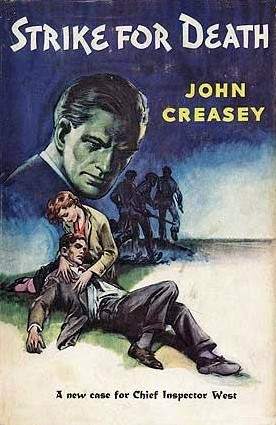
Strike For Death blue

Creasey was a crime writer who created a few similar characters and then cranked out books according to a formula. He had police procedurals featuring Inspector West and Commander Gideon, and also a more hard-boiled series featuring The Toff, an upper-class fixer and sometimes private detective. Those are the three series I dipped into. He’s got others I haven’t yet tried.

What I like most about the Inspector West series is the image of 1950s England that it presents. It’s a country with strong collective spirit rebuilding after the war and not yet suffering the onslaught of mass immigration. The Brits still have a stiff upper lip but the war is too recent for them to have gone soft. The Soviet Union is a new menace and constantly meddling in UK affairs. West is a rising star in Scotland Yard. Unlike modern police procedurals, Creasey doesn’t do any post-modern bullshit with “complex” flawed characters. West is a hero. He’s a modest family man with good judgement, strong moral code, and a commitment to correct procedure. He’s not a haunted alcoholic like the hard-boiled detectives, he’s not a rebellious rule-breaker like Dirty Harry, nor is he a pompous virtue-signalling psychiatrist like Alex Delaware.

I like stories where protagonists are men with a real life worth having, and a commitment to doing the right thing. There’s not a lot of melodramatic flourish in the West stories. He doesn’t leap from moving trains, or quick-draw to shoot down a gang of thugs, nor does he disarm a bomb one second before the presidential motorcade arrives. He’s just a solid copper doing the right thing, with a little flair.

This realness to his character, where if he’s working late he phones the wife to tell her not to wait up, brings the story to life [10]

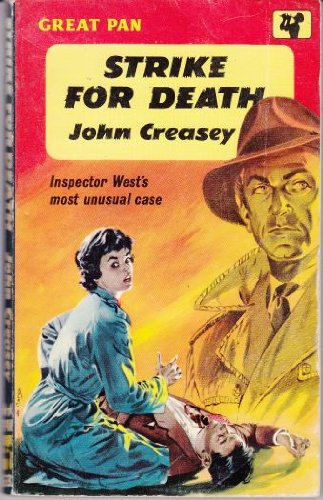
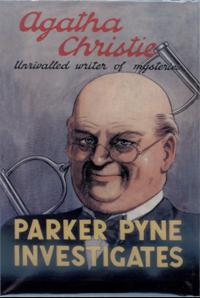
Strike For Death

She looks like a Croat I fucked

This maturity and realness spreads into the subject of Strike For Death. I’m sure you’re thinking it’s a vulgar potboiler, to judge from the lurid cover. Nope. The story is that a big car factory is rolling out a new model that will pull in lots of export orders. The union is agitating for a ten percent pay rise and as tempers flair, there’s a murder. Scotland Yard is brought in to solve the case, which rapidly evolves into additional violent incidents.

As a narrative experiment, Creasey seems determined to keep almost the full book on factory premises. There are brief interludes where West returns to the Yard, and one key scene in the factory owner’s house, but for the most part it’s all on-site. Creasey pulls that off well and makes the factory one of the characters.

I liked how he handles the industrial dispute. This is not a simple case of good vs evil, either on the side of the owners or the union. Creasey takes care to present both the chief shop steward Michael Grannett and the board CEO Sir Ian Munro as sympathetic characters who have a sincere commitment to their ideological positions yet also somewhat bull-headed and prone to dismissing opposing points of view. Grannett is doing his best to protect the interests of his workers and Munro is trying to keep the factory profitable in tough times. The conflict is due to a balance of conflicting and shared interests, rather than a simple white hat vs black hat.

Nothing annoys me more than when a writer decides the bad guy’s motivation is simply “because he wants to do bad stuff”.

Books reflect the spirit of the times. In 1958 England was a different place with different concerns. Balance of payments was a big problem and thus foreign currency earnings through exports were a big deal (this is part of the book’s high stakes), workplace agitation by KGB-backed shop stewards was a massive problem [11]. The UK economy was heavily nationalised in 1958 and regulation stifled everything.

It’s almost quaint to see what types of crimes were the focus of fiction, and what type of criminals committed them. In this case there’s a murder of a young worker by someone on the factory staff. The entire case is local and the motive is one of the big three : greed, jealousy, revenge. There are no ISIS terrorists setting off bombs on busses, no Muslim immigrants setting up child-rape gangs in provincial cities, no Yardies hacking each other with machetes over failed drug deals.

This was a time of East End riff-raff robbing a post office, of a wife poisoning her husband, or a jealous teenager stabbing a love rival.

Honest times.

crime

The good old days when criminal and victim alike wore suits

There’ll be an announcement very soon about a small project I’m working on. Thanks to those of you who took me up on the Winter Memoir Challenge. There are now SIX books in the works, that I’ve been told of. Two guys have already sent me significant first draft manuscripts for my review. I’m starting to think 2018 may be the a bountiful year for daygame literature.

[1] I play video games this way too. The very last thing I do is the main quest line, and any time an NPC tells me “you must…” I immediately try to kill him.
[2] Here’s a rule of thumb. Anytime you’re told “this time it’s different” or “it’s a new type of economy now”, get out.
[3] I’m old enough to remember when people took HookingUpSmart seriously, and I’m waiting for people to give up on the Dark Triad fairy story. I’ve been told that Instagram and Seeking Arrangement are the “new game”. This time it’s different.
[4] Or to take a telling, as some friends have told me
[5] For example I’ve been saying for years that Obama is the worst president in history, a stooge for the Chicago mob, a vain fruity narcissist of middling IQ, raised and groomed by Saudi Arabia as a Manchurian candidate, not even a US citizen, and that he’s neck-deep in the worst political corruption in US history and will likely go to jail for it. Right after his election I stated he was a classical Mussolini-style fascist in how he worked with Wall Street in corporate America. I wasn’t the only person saying this, but it was considered the lunatic fringe by the gatekeepers of the narrative.
[6] Speaking of which, I finally watched The Girl On The Train movie last night. Absolute shit. In contrast I thought Get Out was brilliant and absolutely NOT the movie the critics said it was.
[7] That might be a slight exaggeration.
[8] Such as Spanish film director Jess Franco or his Italian equivalent Joe D’Amato.
[9] I consider my own memoir series to be my writing apprenticeship.
[10] Incidentally, this is how daily soap dramas like Eastenders should’ve been. Instead of revelling in door-slamming dysfunction of mongs, they could’ve shown real people trying to do the right thing. Still, that would subvert the cultural Marxist agenda so it was never going to happen.
[11] And didn’t stop for a long time. For example , KGB agents were everywhere in the 1984 miner’s strike in an attempt to bring down the Government and also behind the CND’s attempt to unilaterally disarm the UK.

#9 – Barbarian Tides, Time Life BOOK REVIEW

January 24, 2018
krauserpua

I’ll admit I bit off more than I can chew. That is a constant in my life, as I’m also finding out writing volume three of the memoir (Younger Hotter Tighter). Projects seem so much faster in my mind. These Time Life books are each 175 pages long and those pages have plenty of words on them. Real books. Not like skimming a magazine. End-to-end that’s over 3,000 pages. Fuck me. Well, I want the knowledge so I’d better keep reading.

Time Life series

The totality of my ancient world knowledge, yesterday

One of my favourite bloggers, Vox Day, likes to say “immigration is war” and that there is no “magic dirt” that will turn a non-American into an American simply by having him change location. I agree with both sentiments but it was not until reading Barbarian Tides that I appreciate this is historically obvious.

The Left, you see, hates history. It’s always Year Zero with those clowns. The very last thing they want is for us to learn the mistakes of history. They’d much rather we repeat them. They are the People Of The Lie. [1] Thus Leftist history is always about airbrushing wrong-thinkers out of history and then ‘revising’ the record to completely pervert it. Hence all that nonsense about Shakespeare’s plays being written by a black woman, Mohammedans inventing science, that Constantinople is Istanbul, and so on.

Volume two of the Time Life series picks up circa 1500BC as the great Ancient civilisations are beginning to fail. Some are hit by natural catastrophes such as an earthquake and volcanic eruption rendering the Minoans vulnerable to barbarian Mycenean invasion [2], while others fell to internal decline such as the hated Assyrians losing their military prowess and being pushed back by the Hittite barbarians from the Eurasian steppe. The Egyptians also disappeared up their own arseholes when they first let a woman run them (Hatsheput) and later a gamma fag Akhenaten who was so full of himself he changed the entire religion from worship of Amun-Re to Aten and then tried to build a new capital city in the middle of nowhere. Naturally, that didn’t work out well.

akhenaten17

Incredible that “gamma face” is clear even in stone sculptures

The meta-level trend emerging from this period of history is pretty clear. The near east, Asia Minor (Turkey, basically), and the Mediterranean was a hotbed of competing tribes and empires. As one grew dominant it would invade the land of it’s neighbours, and then be pushed back as the worm turned. Each time, the new destroyed what they could of the old. Temples smashed, people enslaved, languages disappeared and so on.

When one group was pushed out of their lands they would migrate to new lands, asking for tolerance and mercy (or just plain invade). They’d settled and then soon after overthrow the people who’d welcomed them in. For example, the Hittite barbarians were forced south from the steppe by a tribe of stronger barbarians. The Hittites settled in Anatolia, subjugating the locals, and then built their own empire. It rivalled Egypt in size and the two frequently clashed around Syria. Then a “sea people” [3] in 1300BC arrived and:

“Whoever they were and wherever they came from, the attackers obliterated the Hittite world, reducing Hattusa to ashes, smashing stone sculptures, slaughtering much of the population and driving the rest into exile. And so, in 1200BC, the Hittite empire vanished.”

This was a time of war, conquest and annihilation.

Here’s another lesson from history that the myopic Left would do well to learn: everyone was at it. It’s common for those of us raised with a Western education to think that it was the European empires that were evil. Colonisation is bad we are told. There is something unique and awful about Europeans and those of us around today must pay penance, or reparations, or just feel guilty for all these horrible things we did as colonisers.

FilePane-Archaeologist_Henry_Layards_image_of_Nineveh

Nice civilisation you’ve got there. Would be a shame if someone SMASHED IT

Except, everyone was at it. All those other colonisers – which, frankly, is everyone throughout history – are wiped clean from memory. It’s the European colonisation that we should focus on, the Left says [4]

History truly is fascinating for putting things into context. For example, Christians make a really big deal out of the Exodus of the Israelites from Egypt in 1230BC, stopping off at Mt Sinai to pick up the ten commandments, then settling near the Dead Sea, from which they promptly engaged in exactly the same sorts of wars as everybody else. In the Christian world that little episode is a huge deal. In this book, it’s just a minor thread in a broad tapestry of warring empires and barbarian tribes. [5]

I’ll admit I’m struggling a little in my recall and sense-making of this era because so much of it is new to me. When reading about Egyptian pharaohs it’s easy to slot the new information or interpretation into what I’ve been taught already, same as more recent history such as Napoleonic Era. It’s rather harder to get a grasp of the Phoenician sea trading empire that founded Carthage in 900BC, or exactly how the Mycenaens became the Greeks, or how Etruscan city states merged with the Latins to become Rome [6]

I’m a little more educated in world history than I was a week ago, but I suspect there’s a lot more left to learn.

If you enjoy reading these reviews then you should probably leave a comment now and then because although my traffic is a little higher than usual I have no idea if my readership actually gives a shit. I had many requests for Count Cervantes-style content and now that I’m moving in that direction… silence. Which is exactly why I closed down Count Cervantes in the first place.
20e5

This is why we can’t have nice things

[1] Okay, Mr Triggered Socialist. I understand…. ooookay, so when socialism was tried in China it led to massive famine, economic collapse, millions of civilians murdered by their own government, spying that turned the whole country into an open air prison, and a complete destruction of civil society. Same thing when it was tried in Russia, Ukraine, North Korea, Venezuela, and Cuba. Next time it’ll be paradise! Next time!
[2] The Mycenaens themselves were smashed by the barbarian Dorians.
[3] About whom very little is known. They appear to have been raiders and pirates.
[4] Just as how the Left is obsessed with the trivial slavery of the US and blames all that on white Europeans despite the fact nearly all the slaves were sold to them by other blacks in Africa and that 90% of slavers were Jewish. And even then, the US/European slave trade was much smaller, far less brutal, and lasted a far shorter time than the Arab and Ottoman slave trades. Indeed, in Libya and Dubai it’s still going on today.
[5] Kind like you banging a pretty bird is a big deal to you, but she’s just one of millions of hot birds getting banged out that evening around the world.
[6] Is does seem pretty clear, though, that the Assyrians were utter cunts. They were the Ottomans of their era.

#8 – Parker Pyne Investigates, Agatha Christie BOOK REVIEW

January 23, 2018
krauserpua

During my hibernation periods I often go down to a local seaside market on Saturday mornings to have a coffee with my brother and then walk along the cliff sides, or if it’s really cold, to read a book in a pub. There are several used book stalls at the market and a year ago I could pick up volumes in the recent Agatha Christie reprint series. Check out the second-top shelf in the bookcase photo for how that little collection is progressing.

I have a big problem with reading Agatha Christie, the queen of detective fiction. She wrote eighty detective novels, a dozen volumes of short stories, and another ten books under pseudonyms. I’ve read over fifty of them. The only problem is, I don’t know which fifty.

I didn’t keep a list.

This is how it happened. In the year 2000 I got a job teaching English in a Japanese junior high school on a small tropical island in Okinawa. It was extremely isolated and the internet back then was still 56k dial-up. My parents would send out some paperbacks, I’d watch SkyPerfectTV cable, and I’d play every single Sega Dreamcast game [1]. There wasn’t much else to do. A few times that year I flew up to Tokyo during school holidays and hung out with my now ex-wife. It was a huge change of pace – from a tiny island with 2,000 inhabitants to the wild metropolis of central Tokyo. I’d be there over a week at a time and some of the most enjoyable periods were sitting in Starbucks, in sofa chairs, reading paperbacks and chatting a little. Just enjoying some quiet time together.

Jiyugaoka

I spent a lot of time in Jiyugaoka

Little did I realise, but this was where I made the following deep emotional connection:

Cafe + Sofa Chair + Paperback = Happiness

It’s never left me and remains one of my most satisfying pastimes. When my year in Okinawa was up I flew back to Newcastle and spent the next four months relaxing. I had a daily routine in which I’d take the bus to the city centre, buy an Agatha Christie paperback in Dillons bookstore, then sit in Starbucks reading it. I read at least two dozen of her books in that short time period. As years passed, I’d read more. And then I’d completely forgotten which I’d read and which I hadn’t.

With Agatha Christie it’s not as simple as reading the back cover to figure out if you’ve read it already. The stories are so formulaic, have such similar settings, and the protection of plot twists is so important, that the back cover blurbs are no help at all. Three times in a row I bought a book, sat in my sofa chair, and then twenty pages in I realised “I’ve already read this one!” So, I stopped reading Agatha Christie.

Ten years passed and I’m dipping my toe back in. I figure that even if I’ve read them before, with my advancing age I’ve probably forgotten whodunnit. So, we come to Parker Pyne. I knew for sure I hadn’t read anything with him in. Agatha Christie is a genius. Her most amazing achievement is her ability to create to enduring detectives who have completely opposite methods of detection. Consider this:

  • Hercule Poirot is a man of painstaking method and deep logical thinking. The fat little Belgian will carefully observe a crime scene, game out character behaviours, and logically deduce likely suspects. He then makes further researches, usually knows the killer by the halfway point, and then sets a trap where they will be exposed, usually in front of a room of witnesses. Poirot is above all a man of logical deduction. He uses ‘the little gray cells’
  • Miss Jane Marple, by contrast, is an intuit of human nature. She’s a sedantry old granny who sits in the corner with her knitting, quietly watching and listening. She observes behaviour and character. As a former busy-body, she has an encyclopedic knowledge of every character in her village. When elsewhere, she logs her observations and then thinks, “which of my friends does this new person most remind me of?” She assigns people to character types. Thus she can intuit the behaviour of a new person based on her experience of the old people. Miss Marple is above all a lady of character observation. She uses her gossip database.

Parker_Pyne_Investigates_First_Edition_Cover_1934

Parker Pyne didn’t catch on with the public imagination but I was certainly fascinated to see how Christie would draw her protagonist. What would be his USP? I’m not quite sure. His backstory is that he worked in a government office of statistics for 35 years and upon retirement opened a private consulting agency concerned not with murder but with happiness. It would appear he’s intended to be an actuary who uses statistics to predict individual cases.

Ooooh.

It’s a short story collection, written in 1934, but each follows the previous story including the latter half of the book in which he takes a case at each leg of his Middle Eastern tourist trip. They all begin with a prospective client reading his regular advertisement in the Times, that read:

Are you happy? If not, consult Mr Parker Pyne, 17 Richmond Street.

Pyne has an agency hiring two regular staff, a reformed rake (‘lounge lizard’ in the book) who has retired from his gigolo ways but uses those skills to help clients. The other is a stunning vampish women who plays the same game from the other side. Pyne hires them, in the London stories, to create dramas scripted by his third employee, a popular novelist. It’s a great book and I read it cover to cover in one afternoon. It has all of Agatha Christie’s hallmarks: fast efficient characterisation, unpredictable but fair plotting, dark deceptive villains, and a remarkable sense of humanity in the good people.

The reason it’s interesting for this blog is that Agatha Christie knows Game. Oh, does she know game! Consider chapter 4, The Case Of The Discontented Husband. It concerns a young man who consults Parker Pyne because his wife has fallen out of love with him and is now carousing with an interloper. They have agreed a divorce but he’s against it. I won’t type out any sections. Instead I’ll post them as photos.

As you read, consider Game concepts from blogs such as The Rational Male, Heartiste, and of course this writer’s humble contribution to the Game. I’ve annotated it to help you.

27140823_10208964782351524_513546625_o

The PUA industry predates our own efforts

1. Women instigate most break-ups and do so by monkey-branching onto the next man
2. Pedestalisation
3. When a girl goes cold on you, you can’t do anything right. It’s not about you, it’s about her body telling her to GTFO
4. Men who sing the birdsong can attract the bird out of another male’s nest. That’s #9 of the sixteen commandments
5. That’s #8
6. Amused mastery, treat women like children
7. That’s #2 of the sixteen commandments. Dread game
8. That’s #2 again
9. That’s #16. When you are willing to walk away, she’ll block your exit
10. Women use their man as a foil to play the status game amongst other women. Dalrock has a lot to say about this, particularly the status of being a “wife”.
11. Make her work, make her chase. Don’t let her in too easily.
12. Boredom is the kryptonite of LTRs
13. Cheaper than my coaching
14. See Rollo’s life-cycle for why this is the period of peak danger for women blowing up their families for one last shot at new male DNA.

Here’s the lesson of the day: there is nothing new under the sun.

If you’d like to learn how to understand human nature in order to solve mysteries, you can’t do better than Daygame Infinite. That is a 524-page tour-de-force on how to understand hot girls and to solve the mystery of “how do I get them to have sex with me?”

[1] Metropolis Street Racer, Sonic Adventure 2, Soul Calibur, Crazy Taxi 2, Virtua Tennis 2, NFL 2K, Unreal Tournament, and Outrigger were my favourites.

#7 – SS Kampfgruppe Peiper, James Lucas BOOK REVIEW

January 22, 2018
krauserpua

World War II was a wonderful thing. Not so much the butchery, destruction, and surrendering of half of Europe to the Bolsheviks. I’ll admit that was rather unpleasant and I’m glad I wasn’t around to live through it. What WWII did do was inspire a ton of really cool books, movies, and video games. That’s a legacy I can enjoy.

Perhaps my second-favourite writer of all time is Sven Hassel [1]. Now, I’m not for a moment suggesting he is the best writer, just that I personally really enjoyed his books. Starting in 1953, a mere eight years after German defeat, Hassel released the first of his fourteen books, The Legion Of The Damned [2]. I’ve read them all and found only the first and last to be a bit shit. If you’re interested, start with his second book Wheels Of Terror.

Legion Of The Damned

As much a “Documentary” as the average PUA memoir is, sadly

They were quite a success. He sold 53 million worldwide and 15 million in the UK alone.

Hassel did a few very clever things to make his books sell. First of all, they are written in first person perspective in the memoir style and for many years he led the reader to believe they were factual [3]. In addition to this, it’s a vivid immediate style that puts you into the centre of the carnage. This makes compelling reading. The precis is he’s a Danish teenager who went to Germany early in the war to join a German foreign legion. He deserted over falling in love and was arrested and sent to a brutal military prison. The Nazis offered a way out for political prisoners, deserters and criminals by forming penal battalions who got the dirty jobs on the Eastern Front. Hassel joins one, makes new friends, and is horrified by the war. That’s where volume one ends and the rest are continuing adventures of his small band of merry men.

It sets up a neat narrative device in which a Nazi penal battalion of anti-Nazis is fighting the Allies under horrid conditions. Half the books are about the horrors of war, and the other half is R&R time back in Germany where they are drinking, whoring, and officer-baiting. Hassel deliberately removes any context from the war. The soldiers are in a permanent haze, sent into one suicide mission after another without any understanding of grand strategic objectives. It gives the books a compelling dream-like quality [4]

The Hassel Industry

Those imitators certainly knew how to hustle

I thoroughly enjoyed these books. The characters are memorable, the war scenes exhilarating, and the officer-baiting hilarious. Once I’d finished them all I was disappointed at having no more to read. Fortunately an entire industry grew up around the Hassel style, as hack authors tried to get a piece of the bestseller action. Just look at how the covers are done to guide the reader.

I’ve tried these other writers and read some decent potboilers but it’s just not the same Hassel-like experience. They can’t match his flair or energy. While at a weekend market I was perusing a book stall of military literature when I came upon another Hassel-a-like. This one was from a tiny press, possibly even self-published [5]. It was only a few quid, so I picked it up. It sat on my shelf for a year until I tried it this year.

James Lucas Jackboot Series

My first surprise is this is just the first of the Jackboot Series, the second and third in print too and the fourth and fifth forthcoming from another author [6]. I start reading. The preface explains that the author had discovered the diary of a former SS commander in his personal effects after he died in a suspicious fire. Piecing this together with known military records, Lucas reconstructed a particular real-life 1943 Eastern Front mission in which an SS group rescued the 320th Division from a Red Army encirclement. “Faction”, I believe it’s called.

I smelled bullshit. This is a variant of the Sven Hassel memoir hoax.

As I read I find it’s written like Sven Hassel, if he’d calmed down a little. It has the same brutality of war, the same pompous German commanders, the same sadistic NKVD commissars, and the same disillusioned front-line troops. Only….. the Army men are all rather more professional than their Hassel equivalents and the entire novel is firmly contextualised into the wider battle strategy.

Perhaps it’s not bullshit, I wonder.

I won’t spoil the story but suffice to say I enjoyed it and the quality of writing was far higher than I’d any right to expect from a small-run book from a tiny publishing house. It’s as polished as anything you’ll pick up in a real book store. The only real weakness is Lucas isn’t especially good at drawing characters. It takes a long time for the principle men, the commander of NKVD, of the battle group, and of the Siberian penal battalion, to take shape. They don’t leap from the page like the larger-than-life men of Sven Hassel’s work.


Throughout the book, I couldn’t help but root for the Nazis [7] but it was also hard not to root for the Russian troops too (not including the NKVD scum). I was at an emotional stalemate. It’s hard to enjoy any war book in which white people are killing white people. Especially when it’s the Jews setting them against each other.

Incidentally, this is a similar reason to why I don’t watch action movies anymore. They are just a long murder fantasy in which we’re supposed to enjoy watching our own people getting slaughtered for fun. I don’t care to play that game [8]. That’s probably why I’ve had Wolfenstein II The New Colossus sitting on my hard drive since Christmas and can’t make myself play it.
Wolfenstein

I swear, some people are shameless in their imitations nowadays

Anyhoo, something didn’t smell right with James Lucas. He was too well-informed and too sedate to be just another Hassel clone. So I looked into it. Well….. he’s German. That’s ironic considering how the Hassel Craze had English writers pretending to be German or Russian [9]. He’s also an actual military historian who has written over twenty scholarly works.
Oh. I got him wrong, didn’t I.

Reviews of this book seem split between whether Lucas has done an historically accurate fictionalisation of the real operation, or if he’s overly embellished it. Now that I think of it Lucas has somewhat realised the original promise of Sven Hassel – to tell a true story of the horror of war in an entertaining pulp-novel style format.

My conclusion? If you want entertainment I’d still try Hassel first, but if you want some connection to real history it’s worth looking into the Jackboot series.

If you’d enjoy a lurid first-person adventure story about a team of degenerates invading Eastern Europe for boozing and shagging, you can’t go wrong with my Daygame Memoirs. If you are more tactically minded, you’d likely prefer my strategic manual Daygame Infinite

[1] Robert E. Howard is number one. Much of his stuff is public domain now and available for free here.
[2] There are rumours his wife wrote it and he wrote the next thirteen. It’s certainly written in a different style to the others so there may be truth in this rumour.
[3] You needn’t look too far into military history to verify or disprove his claims. It’s simply impossible for anyone to survive that many battles over six years. John Wick is more plausible.
[4] And no doubt made them much easier to write by removing one of the major narrative constraints
[5] And back when it was printed, that was usually a bad sign. Different market then.
[6] It appears they never got published as I can’t find a single thing on the internet about them.
[7] Mind you, it’s hard for me to go through any day without wishing they’d won considering that the alternative was Jewish Bolshevism. I’m no fan of the Nazi’s socialism nor their murderous Teutonic supremacy, but the Soviets were bigger villains. Like Churchill said, “we butchered the wrong pig”
[8] It’s always men getting massacred, usually by a white knight protecting a woman. That’s hard to support when you’re on Team Man. In modern times it’s usually white men getting massacred, which is hard to support when you’re on Team White. And before you stupid Indian trolls get started, think how you’d feel if Bollywood created movies like John Wick where you were meant to cheer for two hours as somebody massacres several hundred men who look exactly like you. Even worse if it’s like Django Unchained. Imagine a Bollywood movie where every single Indian man is a total cunt, and then a white man kills you all, and you’re meant to cheer it along.
[9] For example, Leo Kessler is in fact Charles Whiting and Wolf Kruger is schlock horror writer Shaun Hutson.

#6 – The Age Of God Kings, Time Life BOOK REVIEW

January 21, 2018
krauserpua

Too much fiction, mate. That’s what I thought to myself as I realised the first five books I finished this year were all primarily about the entertainment rather than the learning. Winter is my time of reflection and self-improvement so Project High Value Man must continue.

Having long since gotten tired of David DeAngelo videos and Muay Thai fights on Thai television, I’ve been looking into new ways of peacefully sending myself to sleep at night. My latest wheeze is to listen to audio books of titles that intrigue me but that I know, deep down, I’ll never find the time nor inclination to read. I started with a Warhammer 40k Horus Heresy audio but that just confused me and gave me nightmares about the extinction of mankind [1]. So, I moved onto Edward Gibbons The Fall And Decline Of The Roman Empire.

This book holds a very special place in my heart, considering I’ve never even owned it, much less read it.

fall-of-rome_2184860b

“How did this happen?” I wondered

To me it’s the poster boy of a significant contribution to civilisation. As a work of scholarship it is massive, detailed, and draws together a wealth of sources the author mastered through a lifetime of study. As a work of history it is original and groundbreaking. As a work of literature it is immense and intimidating. It stands alone, a monument to the man.

It’s like the K’rauser Romances of 1776.

So as I tucked myself into bed under a fur blanket, reduced my wall TV backlight to zero, then let the audio book wash over me, I was transported into ancient history. Pretty soon, I realised a problem: though I’d love to get my arms around the major trends of history, this book is just too big and too detailed. I’d get lost in the weeds. I needed something higher level [2]

Where can a man go to find a broad-strokes sweep of human history, written by subject matter experts, and lavishly illustrated so that tiny ADHD minds such as my own don’t get bored? Well, Time Life of course. They produce beautiful coffee table books on a range of topics [3] for a lay reader with an inquisitive mind. Incredibly, I could get the 19-volume [4] hardback set for just £35 delivered, via eBay. So that’s what I did. They now form a very nice row at the bottom of my bookcase.

imgp1210

There’s more knowledge in here than there is inside my whole head

“Nick,” I told myself, “this is your chance to become well-educated. A chance to make up for all those wasted years chasing girls and bragging about it. A chance to undo the damage that non-stop video-gaming has done to your feeble mind.”

“It’s winter. There’s nothing else to do. Look outside – it’s snowing!” my inner voice continued. “Here’s a project for you. Read all nineteen volumes in order. They go right up to WWII and after that you’ll literally know the shape of world history. Do it! Do it now, before your ageing mind fossilises forever!”

I picked up volume one, The Age Of God Kings, and the synchronicity hit me. It’s all about Sumeria, Egypt, Crete and Indus, the oldest empires. Wasn’t I playing Assassins Creed Origins [5] just this past week? Isn’t the God King Donald J Trump president right now? Yes! I must read this now.

Craig Cassidy

“I literally just saw you. You look Sumerian, probably from Umma or Lagash”

Having finished volume one this morning I can say I have every intention of moving on to volume two and beyond. Here’s just a short list of morsels I picked up through reading:

  • I can now find Mesopotamia on a map.
  • I appreciate the importance of rivers and how the predictability of their flooding will lead to either a stoic fearful religion (Sumer, where Tigris and Euphrates rivers flood unpredictably and dangerously) vs an optimistic worshipful religion (Egypt, where the Nile is predictable and controllable).
  • The aesthetic design of pyramids comes from Ziggurats, which themselves came from the practice of building new temples as a layer on top of the ruins of an old temple.
  • A sculpted figurine of Ebih-il, steward of the temple of Ishtar at Mari, looked an awful lot like Craig Cassidy.
  • The anti-clockwise current of the Mediterranean protected Crete from invasion and thus allowed it to build an early civilisation.
  • Now I understand what real life circumstances encouraged the myth of Theseus, the Minotaur, and the labyrinth.
  • Sumerians and Egyptians loved symmetry and spectacle in their architecture whereas Minoans and Harappans were about utility.
  • Egyptians did not in fact walk sideways with their hands pressed together above their heads. Nor did they say “ooohwahoh-ohwaaaah-oohhhh!”
  • The Nile (and Egypt) is effectively two countries, with Upper Egypt a narrow valley country with shallow impassable cataracts, and Lower Egypt a flat marshland with deep navigable rivers [6]
  • Mallia is now a degenerate Cretian holiday resort full of foreign slags getting their tits out. Back in 2500BC it was customary for the local slags to have their tits out constantly too, even at court.
3bd314c079a660946380b9240c8d3dea

Lisa had finished her cocktails and found her way to Candy Club

I could go on, but I shan’t. Suffice to say, I’m feeling rather educated right now.

If you too wish to contribute a Gibbons-esque scholarly work of historiography to the emerging daygame literature, take me up on my Winter Memoir Challenge. If you’d rather just read about it, consider Daygame Infinite. You can put it in a time capsule so future civilisations realise just how much we knew.

[1] Though if it was only half of mankind, and I could choose which half, it would be a far more pleasant dream.
[2] And easier.
[3] Yes, I bought the Nazi ones too.
[4] Slightly larger than my own historiography.
[5] Or, Witcher 3 Egypt as it’s also known.
[6] I’d already figured this out from Assassins Creed Origins.