#101 – Flash For Freedom, George MacDonald Fraser BOOK REVIEW

November 13, 2018
krauserpua

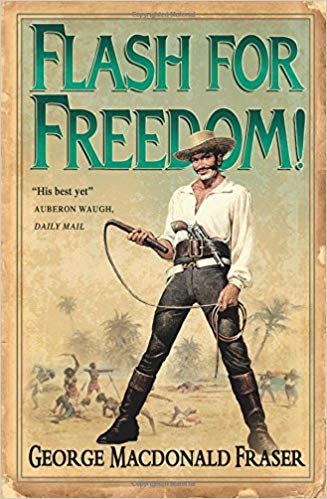
Flash For Freedom

You are all well aware of how heroes swashbuckle through an adventurous tale of derring do [1] in which damsels are rescued from distress, dastardly villains are dispatched to the underworld, and wrongs are righted. You’ll be equally aware of the “anti-hero” archetype, the man of muddied moral compass who doesn’t heed the call of justice but ends up more or else achieving the same results as the hero, grudgingly.

What hero and anti-hero have in common is they are do-ers. Though their intentions differ, they are the engines of the story, pushing through to conclusion. What about a protagonist who doesn’t actually do anything?

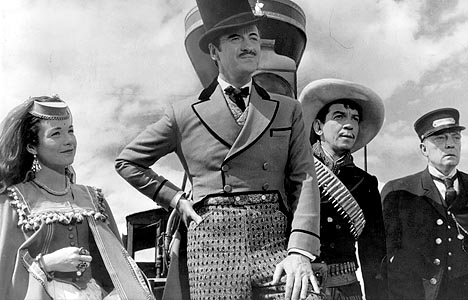
Mr Harry Flashman, he of the Flashman Papers, doesn’t ever achieve anything. In working through Flash For Freedom – the fifth memoir in the chronology – it’s notable how little pro-active behaviour Flashman engages him. He punches a man after a card game when in the heat of rage, and later pulls a gun on a slave-hunter to effect an escape when cornered, but never once does Harry Flashman engage in pro-activity. There is no mission he is on, nor objective to attain. Mr Harry Flashman has only one thing he cares deeply about – saving his own skin.

e60f903b487ed7b9bb48adb90616a549

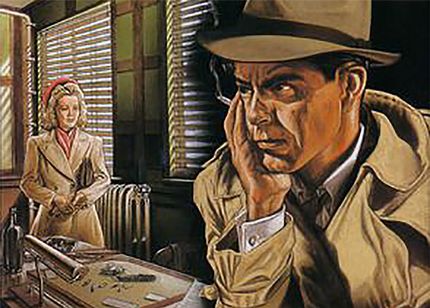
That’s how I picture it

This all kicks off in 1848 in a drawing room of a London industrialist as Flashman is roped into helping a girl he fancies play baccarat after dinner. Also in the game are some Members of Parliament, including Disraeli himself. An old enemy of Harry’s, Bryant, sets him up with a false allegation of card sharping, including planting three cards in his jacket. Flashman’s estranged father-in-law Lord Paisley leaps on his disgrace as a chance to ship him off on a sailboat bound for the USA. Only…… it’s a slaver headed to Africa first.

From there, Flashman is like Old Mother Hubbard swallowing a spider to catch the fly. The ship takes on six hundred negro slaves but barely casts away when the captain, Spring, cuts a deal with the local chieftain for six of his Amazonian female bodyguards. The latter mutiny and several sailors are captured, tortured, and killed. By the time that kicked off, Flashman was already running to safety.

What follows is one unlucky break after another as the slaver is challenged by the US Navy and Flashman must concoct a convincing impersonation of a anti-slaving spy to evade the hangman, which then snowballs into more palaver. What’s notable is that Flashman is never the maker of his own destiny. He’s a selfish coward who never stands to fight, much less move towards danger in order to accomplish a higher goal. At each crisis point, Flashman always chooses the cowardly way out, of self preservation and betrayal, believing it better to run and live to hustle the streets another day.

2221

I see them like this, can’t help it

What makes Flash For Freedom so engaging is how the narrator – Harry – conceives the situations, his feelings, and his assessment of others. It was written in 1971 and there’s not a jot of political correctness in there. The character is a shameless cad, lush, and racist [2] who finds himself both selling Africans into slavery, and then helping others escape out of slavery, according to how his circumstances play out towards best saving his own neck. He makes solemn promises to his companions and then relates in detail how many times he considers selling them out for momentary advantage. It’s the don’t-give-a-fuck directness of the pseudo-memoir style that makes it so engaging, how Flashman is so open and self-aware about his flakiness.

Just as with Black Ajax, I found George MacDonald Fraser to be extremely convincing in his recreation of the time period and the colourful characters within. I didn’t find any jarring anachronisms. You know the sort of thing I mean: women with feminist values in 1848, or blacks in government – the kind of mentality that makes modern Thor a transsexual and James Bond an African. Fraser writes everyone into believable positions for the times, but has no trouble creating fascinating characters. By casting everything into Flashman’s devil-may-care rogering swashbuckling style, it flavours the entire book with a sense of fast-paced facetious action.

Fraser is a good storyteller and this is a compelling narrative. The twists and turns of fate are all outside of Flashman’s hands but it’s his reaction to them – and commentary – that make it engrossing and often humorous. He’s an absolute cad. He has no qualms at all about taking on a job as a plantation slave-driver then pulling black wenches from the cotton fields to bed with him. When the jealous white mistress of the plantation flogs one wench, he simply sends the wounded girl back to the fields and replaces her with another. He’s utterly faithless and gets himself into non-stop trouble chasing skirt, so I imagine if he’d lived today he’d be a PUA. I wonder if Fraser is trying to make Flashman an unreliable narrator – by which the Flashman Papers are Harry’s attempts to create a fictional version of himself to impress future readers who take him at face value. If so, the cad truly hits below the belt.

Sigma Wolf store

If you’d like to read real, as opposed to fictional, memoirs than consider my series Balls Deep, A Deplorable Cad, Younger Hotter Tighter and Adventure Sex, all available here and on Amazon.

[1] My memoirs, for example.
[2] Like me until very recently.

#100 – The Spitting Image, Michael Avallone BOOK REVIEW

November 12, 2018
krauserpua

51nlftxyzsL

You didn’t think I’d reach the magic number of one hundred book reviews, did you? No, you did not. I’m pretty sure you put down your bottle of Soylent, turned to a friend [1] and then in snarky tones said something like “Orange Bald Man Bad. He’ll never get there.” Well, you snarky NPC cunt, here it is. My hundredth book review.

You cunt.

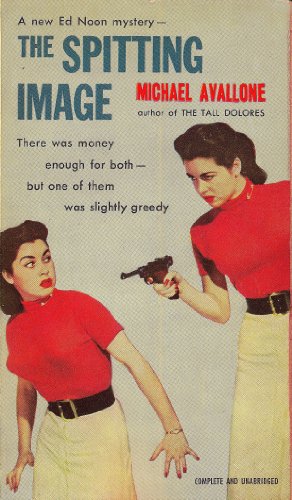
With that out of the way, dear reader, lets get on with my impressions of the second volume in Michael Avallones Ed Noon series, The Spitting Image. Pull out your world atlas, find the page with Hard-boiled City on it, and then find downtown because that’s where Avallone is taking us here – hard-boiled central. This is a seedy side of town with corrupt Irish cops, whiskey-drinking private detectives, and pretty dames you wouldn’t dare make beneficiaries of your life insurance policy.

Dames, especially the good-looking ones, were always getting into trouble. This was a very good-looking one. That meant only one thing to me. A lot of trouble.

This one gets off to a flier. A sassy blonde, June Wexler, comes running into Noon’s office begging his help. Her French chauffeur, Anton, has been putting the moves on her and she’s only just shaken him off to find her way to Noon [2]. Now, Ed Noon wasn’t born yesterday, I can tell you that, so he’s immediately suspicious. Halfway through the interview, Anton comes in and suddenly June seems to goad him into attacking Noon with his French savate. A tear-up ensues but the fisticuffs are rudely interrupted by an unknown stranger who fires through the doorway and shoots Anton dead before running off.

I stepped over Anton and went to the telephone. The Wexler dame was still crying. I looked at my watch. Eight-thirty-five. And I hadn’t had my coffee yet.

It turns out that June is the twin sister of April, both of them socialite heiresses about to inherit a huge fortune. Only, there’s a catch. Their scumbag of a dead father stipulated in his will that only one sister can inherit, and only if the other is dead. If both survive to reach twenty-one, the fortune goes to charity. Their birthday is only a few days ago. June swears April is trying to have her murdered, and suffered near misses already.

md_bb985c4afe67-hardboiledfiction_big-sleep

It’s a good little mystery, including the usual hounding Noon gets from grouchy cops resentful of his interference, and some shyster lawyers, and so on. Noon is a good-looking lad so the dames seem to fall for him but he can’t ever shake the feeling he’s being set up. Hard-boiled fiction is like that, everyone is working an angle and nothing is as it seems.

Avallone has quickly hit his stride with The Spitting Image. There is none of the awkward start like his first book, The Tall Dolores. Like that one, this second book races through with lean prose, push-forward plotting, and no fat on its ass. When Noon finally figures out the mystery, it makes sense without cheap devices.

Two things that really jump out of the Noon series, as I confirmed reading the next two volumes, are (i) Avallone will put in brutal violence, especially against the hot women, (ii) Most of the women are utter cunts. In this story an innocent woman is burned alive and the blow isn’t at all softened. The baddies are not messing around. Many crime writers find a way to ensure pretty women never quite take their lumps [3]. The twin sisters alternate between nymphomania and frigidity, and aren’t very likeable.

It’s a good book. I expect to keep reading the Noon series.

If you want to see a range of real women varying between nymphomania and frigidity you likely can’t do better than my memoirs available here, or my daygame textbooks.

84783858

Probably a slag

NOTE: The paperback Younger Hotter Tighter is currently unavailable while I resolve a printing issue. There’s so much red ink on certain pages that it’s clogging the printing machine (according to Ingram). The hardback doesn’t appear to be affected.

[1] If you’ve got any.
[2] I always said, “you can’t trust the French”.
[3] Unless its a serial killer story, in which case that sexual violence is the whole point. But Noon books are different, this particular story is about greed not sadism. The unlucky woman is simply in the way.

#99 – A Thirst For Vengeance, Edward M. Knight BOOK REVIEW

November 12, 2018
krauserpua

21461298

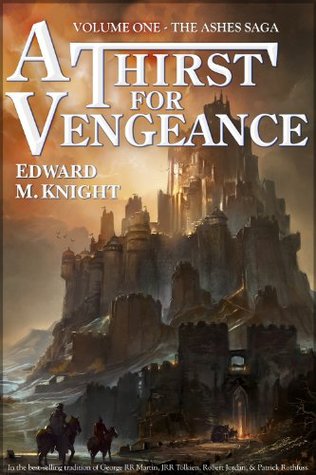
Now that’s a good cover!

What was your worst ever day like? Do you consider yourself to have had a tough upbringing?

I ask this because the main character, and narrator, of A Thirst For Vengeance probably has you beat. The tale begins when Dagan, dubbed the Blind Assassin, sits in a tavern recounting his life to a father and son, Earl and Patch. They keep him plied with ale as Dagan harks back to his childhood and the formative experiences that made him the wandering killer he is now. It’s bleak. About as bleak as the average lad raised in Sunderland.

To start, his mum tries to kill him when he’s two years old. Her new lover is spiriting her out of the village but she returns to thrust a knife through her toddler’s heart. Fate nudges her wrist and she misses, striking his shoulder. He toddles through a blizzard to be picked up by an old gypsy lady who sells him to a human trafficker. He winds up chained to a dungeon wall for six years by an evil brute called Three-Chins [1] where he is abused, tortured, and kept literally in the dark. Those kids are being raised for an underground human cock-fighting ring, The Arena, in the nearby city of Hallengard.

Not all is ill for young Dagan as he’s befriended by Three-Chin’s young daughter Alicia who smuggles him into her rooms where he can hide for several months, finally forming a tender human connection. So, Three-Chins gets wind of this and rapes Alicia in front of Dagan and then murders her. Yep, so far, so Sunderland. Or perhaps Hartlepool.

Finally the day arrives when he’s chained up and caged into the back of the wagon bound for Hallengard. Random bandits attack the caravan, killing the two drivers and freeing the kids. One bandit recognises something special in Dagan and presses a marked coin into his hands together with instructions to show it to the keeper of a temple in Hallengard. Dagan treks off, still only eight years old. Upon arrival in Hallengard he’s jumped by street kids who beat him senseless, steal his coin, and leave him for dead. He turns to begging and street crime. [2]

bully

Trauma like this turned Dagan into an assassin

So, having seen what poor Dagan put up with, do you really think you had it hard when Joannie from third grade laughed at you because Billy pulled your pants down in the assembly hall?

At heart, this is a revenge tale, as the title subtly suggests. Dagan gets trained up by an enigmatic former assassin called Blackstone, who had infiltrated The Black Brotherhood gang of thieves to reclaim some magic knives. Or something. Knight is clearly making this all up as he goes along and I know [3] the entire novel was written in just twenty days. I suspect the planning phase was twenty minutes of that, and editing about two. It all moves along towards Dagan getting trained up until he and Blackstone heist the next big show at The Arena so as to kill Three-Chins and steal all the stake money wagered on the bouts.

There’s big explosions, knifings, sword fights and stuff. No wizards, dwarves, or orcs, though. This is of the men-only fantasy style, like Conan, where even magic is rather subdued. None of that Wheel Of Time soyboy bullshit. I dare say there’s not a single strong female character in the book. The women are only there to be raped and murdered, just like real life.

The_Blight

Soyboy bullshit, yesterday

This book is the usual Kindle fantasy fare so it’s rather a large step down from Robert E Howard, or J.R.R. Tolkien. It’s refreshing that there’s no faggotry at all, either literally in the bumming/Turkish sense, or in the soyboy Terry Pratchett sense. It’s all rough men finding excuses to knife each other after a night of drinking, just like in Sunderland. I don’t especially recommend it but you could do worse if you want a similar story to those old TOR Conan novels. It’s not that level, but then again it’s only 0.99p on Kindle.

If you’d like more bumming-free books full of sex, adventures and no rape (honest!) then try my products here. So long as I can sell a few every day, I can keep up rental payments on my old London lock-up so staff won’t ever open it up and discover the bodies.

[1] No connection to Jimmy Five-Bellies.
[2] And E.M. Knight then drops the whole coin/temple plot for the rest of the book.
[3] Don’t ask me how, but I know for a fact.

#98 – Stuka Pilot, Hans Ulrich Rudel BOOK REVIEW

November 8, 2018
krauserpua

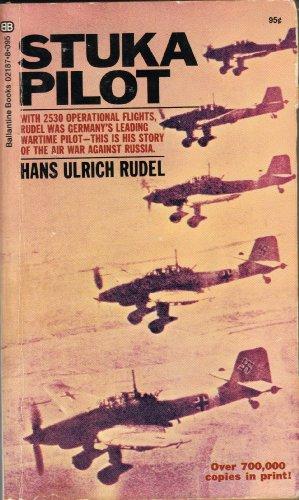
Stuka Pilot

“neeeeeerrrrrrrrr!!!”

The last two books I reviewed were, respectively, a beautifully written pseudo-memoir about a degenerate alcoholic who achieved nothing in life, and a trashy pseudo-memoir full of blood’n’guts on the WW2 Eastern Front. Now, would I be able to find a book that represented the opposite of these two?

Ladies, I present to you Hans Ulrich Rudel’s Stuka Pilot memoir of his experiences throughout WW2. Where Bukowski is a masterful writer, Rudel is dull and factual. Where Hank Chinaski is a worthless bar-fly who will call a day successful if he merely avoids shitting himself, Rudel is leading a bomber command and often destroys ten Soviet T-34 tanks a day. Where Wolfgang Faust is glorifying in the gore and lurid descriptions of Soviet atrocities, Rudel is explaining orders, regimental movements, relative speeds between aircraft and the minutae of a combat pilot.

It really is like seeing a film negative compared to the original printed image. Rudel’s book is fascinating because (i) it’s all true, and could be verified against the vast store of paperwork the Luftwaffe left behind, (ii) he’s an extremely high achiever, (iii) it’s an expert’s bird’s eye view on a massive air war. The fact he can’t write very well doesn’t hurt the book so much. The quality of the information he relates keeps it going.

It’s notable how differently Rudel approaches the Soviets compared to how Faust did. For the latter, their tactical and strategic decisions are not fully explored because he’s a bullshitter rather than a true expert. It’s like watching RSD coaches try to explain daygame. Rudel sees them as worthy enemies and fellow professionals so, though he considers many of them under-trained and prone to poor performance, he’s always judging them according to militarily meaningful criteria: material, position, morale, training, tactics etc. At times I could forget he’s talking about blowing people up.

Aircrew-Luftwaffe-legend-Hans-Ulrich-Rudel-color-portrait-photo-04

Awesome coat

What interested me as a daygamer [1] was to what he credits his success. In flight school before the war he under-performed in class and wasn’t allowed to fly during the Poland campaign of 1939. His weak reputation spread so that even when posted to Greece in 1940 the Stuka commander there tried to keep him grounded. Rudel was frequently sent on training courses in associated skills specifically as a pretext to keep him out of action. This forced him to learn everything the hard way, from every conceivable angle, until he was perfectly drilled. When he finally did get let loose in combat sorties he quickly established himself as a top gun.

His poor start forced him to get everything technically correct, and to understand the theoretical underpinning to everything he did. It wasn’t possible for him to play fast and loose, getting by on mere talent. Anyone familiar with my story [2] will know why that speaks to me.

It’s astonishing how brave Germans could be in wartime. Rudel fought 2,530 operational flights and would frequently discharge himself from hospital to get back to the Front. He was compelled by a sense of duty to his country and a bond to share danger with his wing. I also suspect he was addicted to the thrill-ride of bombing raids, though he never addresses the psychological dimension. A hair-raising escape after crash-landing and capture in Soviet territory doesn’t warn him off, nor does crashing in a ball of flames with two machine gun bullets in his leg. Even getting the other leg amputated after another tank-busting raid won’t stop him and he gets in a few hundred more sorties by equipping his rudder pedals to be hand-operable.

Rudel speaks very highly of Adolf Hitler, painting him as logical, very knowledgeable on wartime minutiae and technology, and warm company. He attributes much of Hitler’s strategic blundering to being misled by subordinates as to the size and distribution of his forces – such as one division being chosen for a spearhead due to it’s sixty panzers, only for Rudel to mention to Adolf that he’d flown over it a week earlier and it had only one tank – which itself was fitted up as a radio control centre to guide the Stuka’s on bombing runs. Sadly, Rudel never settles the issue as to whether Hitler had one or two balls.

It took me four days to read this – that’s a coon’s age in reading time for me nowadays – because it’s so thickly detailed and methodical in presentation. I feel like Rudel is most concerned with leaving a historical record of his wartime experience. This book isn’t written to thrill, nor to be easy reading. I did thoroughly enjoy it and can now say I’m considerably better informed about the WW2 air war than I was previously.

One strange omission is Rudel only mentions Hermann Goerring a handful of times throughout. It’s as though Rudel talked only to his immediate superior or went right up to Hitler. That’s odd, I think.

Fuck all that bullshit mate. Just check out my product page here so you can see all the fantastic books I wrote, including my Daygame Infinite and Daygame Mastery full-colour textbooks which are now selling nicely through Amazon.

[1] Former-daygamer
[2] All six volumes of it

#97 – Women, Charles Bukowski BOOK REVIEW

November 5, 2018
krauserpua

Women

You have probably noticed how daily soap operas on TV, such as Eastenders, are very different to the ‘premium cable’ such as The Wire or Game of Thrones. It isn’t just that “Eastenders is shit” [1] but there are specific stylistic differences in narrative arcs and character development. The big one is this: soap operas don’t have character development.

The reason everyone in Eastenders seems so fucking stupid is not because the writers are incapable of plotting character arcs. It’s that the format demands there not be any. For Eastenders to remain familiar, non-threatening, and easy to dip in and out of, it’s imperative that the characters never learn from their mistakes. Every morning, they wake up exactly the same person they were the day before, month before, year before.

Mainstream series like The Simpsons are even more noticeably static. At least Eastenders has plot arcs that run several weeks, and the circumstances of a character’s life can be permanently altered such as by marriage, death, or merely taking a new vacancy at the cafe or market stall. The Simpsons resets at the end of every episode as if nothing transfers from short-term to long-term memory. I think Ned Flanders never even changes the colour of his sweater [2]

Premium cable is all about redemption, disgrace, elevation, learning…. the characters learn and develop.

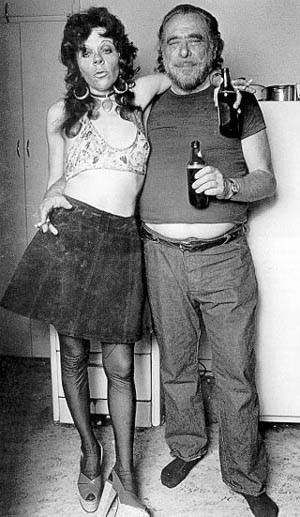
I bring this up because Charles Bukowski’s Women is like Eastenders. His alter-ego Hank Chinaski doesn’t learn a single damn thing through his 106 chapters. He ends the book the same drunken degenerate loser as he begins, with nothing different in his life. He’s taken a few more flights to deliver poetry readings, banged a handful of girls, and drank an awful lot of beer but he’s the same man. Simply older.

It’s deliberate, I think. Bukowski once said, “to do a dull thing with style, now that’s what I call art.” That describes this book. Nothing happens. He gets up, has a shit, drinks some beer, falls asleep, sits in a chair with friends, and maybe has a woman come over. That’s it – 304 pages of a nihilistic loser doing nothing all day. Somehow, Bukowski’s prose is so good that it remains compelling the whole way through. [3] You can really see the poet in him. The sentence structure, cadence, and variety is fantastic. He implies so much more meaning and colour than is present in the words.

I think it’s important to make the distinction between Bukowski the writer and Chinaski the character. Obviously the latter is a fictionalisation of the former but don’t let the book’s gritty first-person viewpoint con you into thinking this is a memoir. It’s fiction. Bukowski said as much in an interview I watched on YouTube. It’s a carefully-woven tapestry of good Bottom-World stories, some he experienced himself, others were related to him, and all embellished. How much? No idea. It’s like reading Sven Hassel. Actually, even the narrative structure is a lot like Sven Hassel, now I think about it. Disjointed, random thoughts and sudden jumps without transition, meant to express the subject’s own disorientation.

732772

+1, solid 8

The women are awful. Chinaski is a magnet for damaged women, mostly whores. Some are literally whores, others are retired whores, and many just might as well be whores. Almost all are on drugs. Every anecdote begins with “Tammy/Arlene/Sara/Iris knocked at my door. She was on pills.” Several have BPD, the most dramatic of which is his first girlfriend Lydia who is the poster girl for BPD single-mother slutty whackjob much discussed on MGTOW sites. I wanted to kill her. Chinaski just takes all her bullshit, making me furious, but I think that’s the point. Bukowski wants the reader to hate Lydia and feel contempt for Chinaski’s weakness.

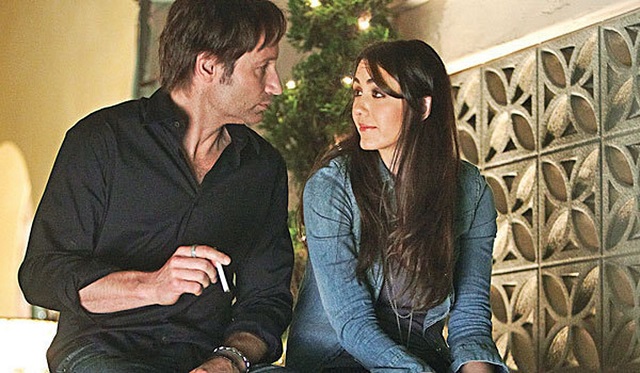
I only watched a few episodes of Californication but it seems Hank Moody is based on Chinaski. Both live in LA, are popular writers, always drinking, and inexplicable pussy magnets for worthless women. I remember when it was all the rage in PUA circles to “learn from Hank Moody’s game”, which struck me as utterly retarded. For starters, who learns about how the world works from fictional characters? Do you learn science from Star Trek, or martial arts from Bruce Lee movies? If you do, you’re a retard. The female characters in Californication are written to throw themselves at Hank. It’s part of the plot.

CGPWV7TE2NEHXMVNG7LNXBYEG4

“I think women lie more than men.”

The same thing happens in Women. Chinaski never actually seduces any women. They just seem to show up. The first few times it’s at poetry readings. He seems to have minor celebrity already as he gets free flights and $500 speaking fee for an hour’s work, and promoters say shows are oversubscribed. At a handful of after-parties, a woman will throw herself at him. Another few times fans write to him and then go visit, throwing themselves at him. Another time two German teenagers show up at his door – on drugs, of course.

There are no descriptions that, in a modern PUA sense, would allow us to divine any kind of attraction, comfort, or seduction. These are girls who are DTF from the moment they enter the story.

I get why PUAs think Bukowski has something to teach about Game, but I disagree. It’s a fictional world and even within it, the women are all dreadful quality. Even the rare few who aren’t whores or middle-aged are still pill-popping sluts. Chinaski comes across as a degenerate, self-hating mess. When I watched a Bukowski interview from 1987 on YouTube he actually came across as humble, and likeable. The writer is more likeable than his character.

Anyway, I really enjoyed this. Rarely has reading about nothing at all been so interesting.

If you’d like memoirs based on stories that really happened, the birds were hot, and there’s clear character development then try my memoirs available here. Just don’t expect writing talent on a par with Bukowski.

https://www.youtube.com/watch?v=EJmQHT_HLOo

[1] Or, “there are no more cockneys in the East End since the third world migrant horde invaded and overran London. God, I can’t wait till they are all deported and the traitors are executed.”
[2] That’s a guess. I know Marge keeps the same haircut. But then again, so does my mum.
[3] No intention plus obstacle, either. No plot at all. Just one thing happening after another.

#96 – The Last Panther, Wolfgang Faust BOOK REVIEW

November 3, 2018
krauserpua

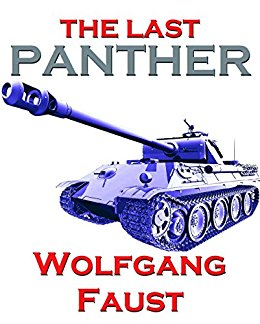
The Last Panther

By 1945 the Nazis couldn’t even afford graphic designers

World War 2 has fascinated me for a very long time. Considering how much time I’ve spent reading about it, watching documentaries, movies, and playing video games…. it’s odd that I still haven’t really made up my mind about it. WW2 doesn’t have a fixed, known place in my worldview. I wonder why that is? Is it because WW2 was just so bloody big? It was tens of millions of people involved, across three continents, and lots going on. That’s a lot to wrap your head around.

Here are a few things I’m not quite clear on:

  • Who started it? The traditional view in the UK is that Hitler wanted to rule Europe so he had a crack at Poland, and France & Britain declared war because of it. But…. there’s plenty to suggest Stalin stoked the whole thing, a gigantic game of lets-you-and-him-fight so as to steal Europe from the exhausted European powers.
  • Who were the bad guys? I don’t think there were any good guys in WW2 [1] but how exactly do you weight them up? Britain carpet-bombed entire German cities deliberately spreading terror through the murder of civilians. Russia raped and pillaged throughout lands they’d previously starved and purged pre-war. Germany was spectacularly brutal on the Eastern Front and keen on reprisals in the Balkans and France too [2]. The Japs were sadistic from Manchuria onward, and the Yanks nuked two cities and did a completely unnecessary firebombing of Tokyo that was even more murderous. No good guys.
  • Who won? All of the Allies, bar USA, had their entire infrastructure demolished and populations susceptible to socialism and mass immigration immediately afterwards. Hard to say that’s victory. Stalin got half of Europe for fifty years. The US gained world supremacy and all of Britain and France’s colonies that mattered.

One thing I am clear on is that WW2 inspired great creative output in entertainment. I have a soft spot for the Sven Hassel novels, which got me interested in the Eastern Front, which is where 80% of the war was actually fought. That got me interested in Warhammer Dawn Of War: Winter Assault and more recently into Red Orchestra 2. Just look at this cheeky bastard.

Looks ace doesn’t it?

I’m so enthused by WW2 that the upcoming second edition of Balls Deep will have a cover heavily influenced by the box and poster art for Company of Heroes 2 and Inglorious Basterds. Bring it on.

Anyway, I’m rambling. I’ve been watching the Netflix series World War 2 In Colour and having a great time. The colourisation works wonders to keep things visually appealing and unlike the History Channel, it’s not all Hitler Hitler Hitler. For the first time I’m getting a broad sweep of the war and an appreciation for how all the pieces fit together. The series explains the context of the Spanish Civil War (I always wondered why the Reds and Nazis got involved picking sides) and how Franco kept the wops out of the Big One. I understand how Stalin and Hitler secretly carved up Poland before the invasion, and why Hitler went after Leningrad, Stalingrad and Moscow at the same time. It’s all fascinating.

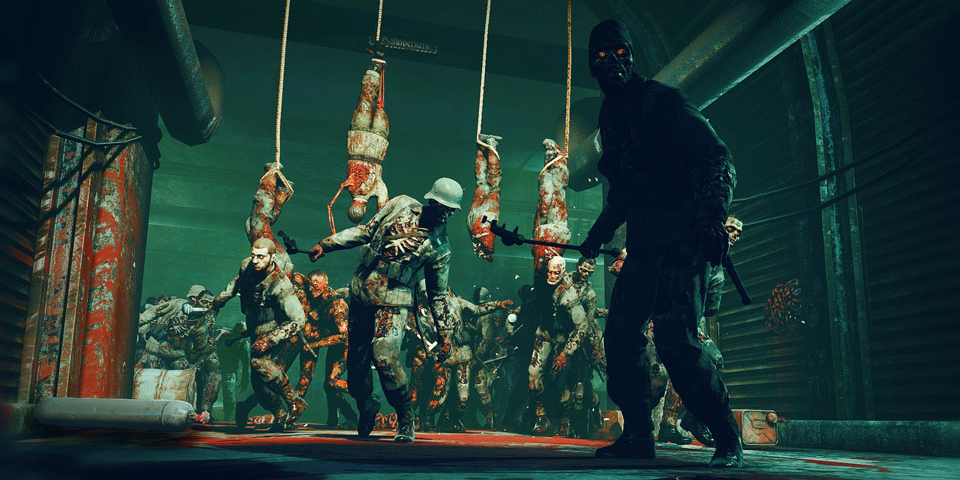
Which brings me to this piece in the grand jigsaw, The Last Panther, in a series of German pseudo-memoirs of the war. Look, Wolfgang, if you really were the world’s luckiest Panther commander then I apologise for making light of everything you suffered and fought for. It’s just that…. I don’t believe you. Now, I’m sure you’re dead but I know all about Nazi Zombies so I’m not about to piss you off unnecessarily. It’s a fun book.

Zombie-Army-Trilogy-banner-image

If you think I’m gonna fuck with THEM, you are very much mistaken

The story is that the Red steamroller has pushed the Germans back into their pre-Operation Barbarossa territory and is rolling them up fast. The German Army is in disordered retreat and now Faust’s division is surrounded in the Kessel Pocket. They are preparing a breakout to the West as this book begins, the plan being to surrender to the USA rather than get executed or sent to gulags by the Soviets. The book then details one long desperate push West.

I liked it because Faust writes with sufficient authenticity to allow someone like myself – who has never seen combat outside of Call of Duty – to suspend my disbelief. He’s definitely taken a page from Sven Hassel’s books in terms of lurid descriptions of battle and the various atrocities committed by the SS and NKVD behind the front-lines. That’s what makes me most suspicious of the book’s non-fiction status – I can’t imagine a traumatised soldier writing such graphic schlock. Sadly, what he doesn’t take from Hassel are his vivid characterisations. The characters in The Last Panther are all flat, often only referred to from their role, such as the Gunner, the Radioman, or the Division Commander. It’s a long way from Tiny, Porta, Legionnaire, Old Man, Heide, and Wolf from the Hassel novels. Those characters live forever.

Look, I’m not gonna stop reading these so don’t try and make me. I get that it’s all trash but there is something immersive about WW2 memoirs. If you haven’t seen it already, have a look at the tankers movie Fury starring Brad Pitt. In particular, watch the scene where they take on a King Tiger. This book is like that the whole way through. You can smell the engine oil.

https://www.youtube.com/watch?v=uP-1vC3tTFA

If you’d rather smell fanny batter, consider my memoir series and daygame textbooks available from my product page here.

[1] Except Clint Eastwood, Lee Marvin, and Pele.
[2] I don’t really hold the Final Solution against them. Just wish they’d finished the job.

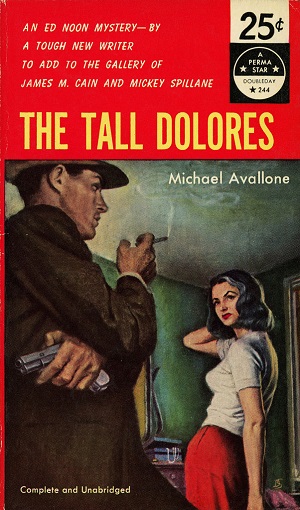
#95 – The Tall Dolores, Michael Avallone BOOK REVIEW

November 2, 2018
krauserpua

Ed Noon Tall Dolores

I told you I was getting a bit of a man-crush on Michael Avallone after reading his woeful The Satan Sleuth trilogy. I’ve also had a thing for his English equivalent, John Creasey. Now, I know what you’re thinking: why on earth get so into ham & egg writers, mere journeymen, when you could be reading the stars? I could be educating myself with the Past Masters series on great philosophers, or learning about a period of history, or indulging in the classics such as Hugo, Dantes, or Tolstoy. Why read trash?

Well, the first answer is that it’s great fun. I may not have studied as much philosophy as I should, but I’m pretty sure those bearded old bastards talked about the importance of enjoying yourself. All work and no play makes Jack a dull boy.

Second answer is that intelligent books are overrated. My general rule in reading life is never buy a book that won a modern award. That’s a guarantee it’ll be brimming with poz. I was also rather disappointed to discover how boring most of the classics really are. Tolstoy in particular is woefully boring. Also, most “great thinkers” simply weren’t. For example, Nietzsche was the first Secret King gamma [1], Marx was a buffoon, Sartre and Foucault traitorous fags and….. well, philosophy isn’t all shit but no-one ever accused Michael Avallone or John Creasey of not coming to the point and clearly writing what they mean.

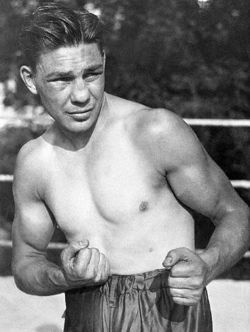
250px-Harry_greb05

The Pittsburgh Windmill

I think the real answer – however – is I greatly admire any man who can be vastly prolific without dropping his quality into shitsville. This goes for most realms of human activity. Thus I greatly admire middleweight boxer Harry Greb who had 299 official fights [2] including the last ninety while blind in one eye. He was a world champ and gave heavyweight champ Gene Tunney is sole professional loss. Equally, I admire MMA fighters Igor Vovchanchin and Travis Fulton, and kickboxer Buakaw Por Pramuk – all extremely active fighters with high peaks [3]. I admire Marc Bolan for writing hundreds of songs, Mario Bava for all his movies, and anyone who bangs lots of hot girls while studiously avoiding swamp trolls.

Avallone and Creasey belong in that company. They race through their work and, if I hadn’t told you otherwise, you’d just assume they wrote at the one/two-books-a-year pace of any other fiction writer. Their work is at the same level. They wrote so fast for so long that they packed in an incredible amount of learning, upped their base tempo, and can do everything others can do… just quicker.

Avallone has covered many genres under many pen names. These include Bronte Sisters-eque gothic romances, horny super-spy thrillers, men’s adventure, and even eight novelisations of the TV show The Partridge Family. But what caught my eye was his hard-boiled detective series with private eye Ed Noon. They were on Kindle Unlimited so I gave it a go.

Avallone Gothic Paperbacks

Call it a hunch, but I think Avallone’s writing had a theme….

I’ve read a lot of hard-boiled novels so, take my word for it, these are good. Not Chandler-good but they are at the same level as most of Hard Case Crime‘s books (which I also like). I’ve read four now and all of them whip along. The dialogue is fresh and cracks wise, the cadence is lean and street-smart, and the plots hang together without any deus ex-machina required. Avallone really found his footing in this genre.

The first in the thirty-book series is The Tall Dolores and it’s the weakest of the bunch, but I still enjoyed it. Noon is in his office when an amazonian blonde walks in and gives him sass. “Dolores was a hell of a lot more than tall. She was huge, statuesque. A Glamazon. A regular Empire State Building of female feminine dame. And all woman, besides.” Her boyfriend ran off with her $5,000 so she’s hiring Noon to find him and recover it. That boyfriend turned up dead – stabbed to death – on the steps of an NYC museum. Everything about the case smells rotten to Noon and he’s soon on the lam from the NYPD after Dolores sets him up for a chink murder in her hotel room.

I love hard-boiled dialogue. It’s so cheesy. I keep trying to remember all the one-liners to drop into my own conversation.

“Ed Noon – that you?”
“It’s the only name I’ll endorse a check with. What can I do for you?”
“Save the wisecracks, Noon. I’m too big to kid around with.”

Some of the descriptions are comically inventive as well. Try this on for size.

Dolores came around the bed with the speed of a big ape. She was still half undressed. I shook my head to clear it, brought my arms up to ward off what I saw in her eyes. It wasn’t nice as near as I could make out.
She descended on me like a tree full of the same apes she looked like. Something exploded against my jaw. Lightning struck twice and I was going down. My eyeballs blew up in a crash of pinwheel crazy colours.

Unlike his The Satan Sleuth books, the Ed Noon stories don’t have any padding. Quite the opposite, they are lean and extremely fast moving. There’s nothing in there that doesn’t advance the plot or build the characters. Avallone has a taste for the dramatic. This book has a circus-tall dame fighting it out in the Statue Of Liberty, book #2 has two twins scheming and plotting, #3 begins with a murder on third base in Yankees game, and #4 has one on Broadway. He likes spectacle in his murder cases, does Noon.

Anyhow, I thoroughly enjoyed The Tall Dolores and it was worth every penny I didn’t have to spend on it. I see myself working through all thirty Noon books over the next few years.

I’ve written a whole heap of great daygame books that you can peruse at your leisure here on my product summary page.

[1] No surprise gamma boys love him. He glorifies being an incel shut-in who rants on about being a superman while no-one reads your books.
[2] And a rumoured 200 not correctly sanctioned or recorded
[3] Fulton is mostly a low-level fighter but he did win a one-night World Vale Tudo 8-man bareknuckle tournament in Brazil.

#94 – Around The World In 80 Days, Jules Verne BOOK REVIEW

November 2, 2018
krauserpua

Around-the-World-in-Eighty-Days

“Hurry up, you froggy bastard”

“What do you reckon, my intrepid pal, fancy traveling around the world in eighty days?” I wrote, completely out of the blue.
“What’s that, say you?” replied Jimmy, “that’s a dashing smart idea.”
“We could re-create Mr. Phileas Fogg’s journey. London to Suez by rail and steamboat, Suez to Bombay by steamer, Bombay to Calcutta by rail, Calcutta to Hong Kong then Yokohama by steamer, and again to San Francisco. On to New York by rail, and finally to London by steamer and rail.”
“I’d best book some time off from work, old chap.”
“Eighty days should do it.”

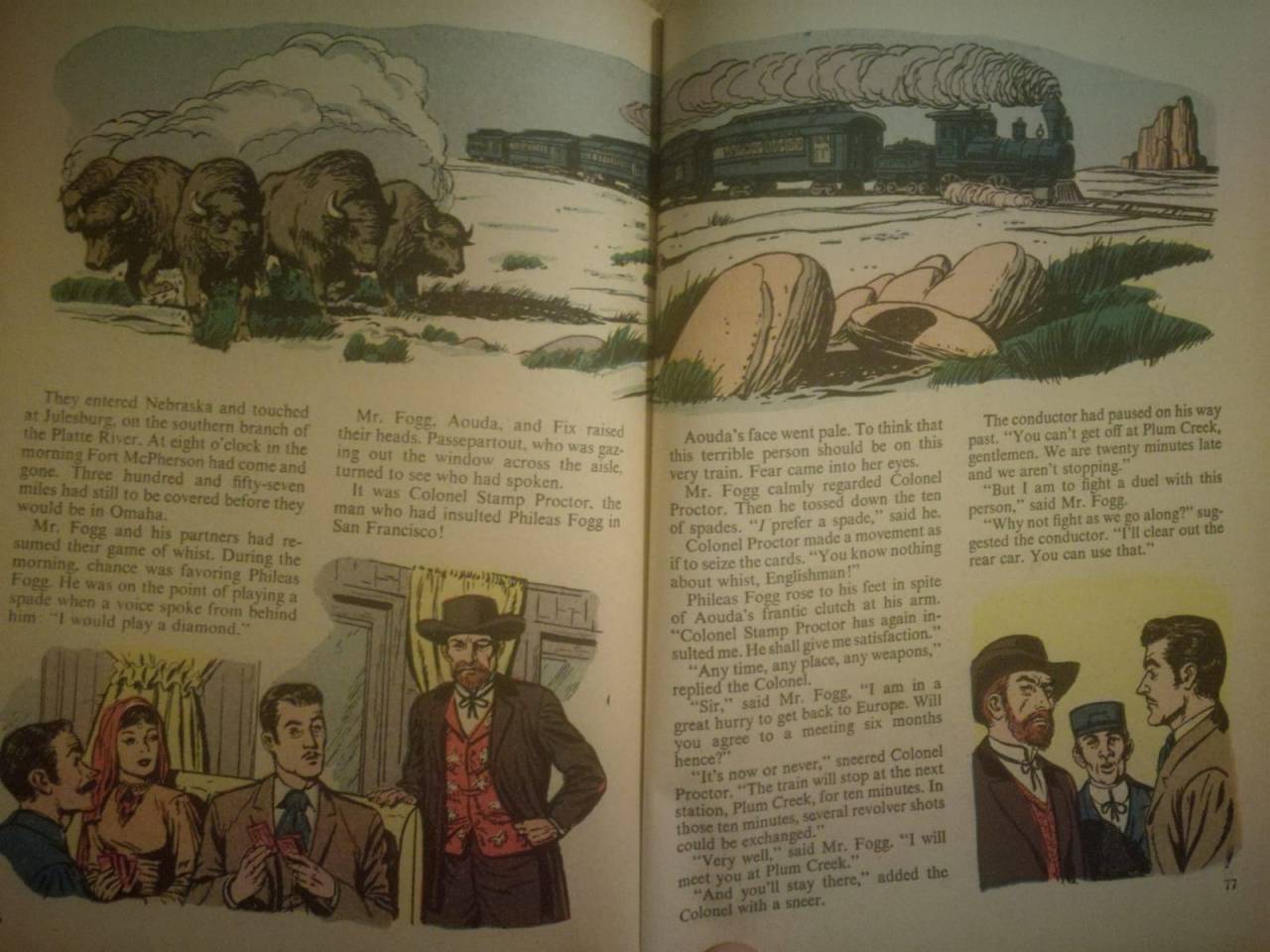
That conversation really happened, but not in those words. You see, I’d been walking along Terezde street past Hotel Moskova and happened to look over a small book stall set up on the street. It was full of the usual local language nonsense but one book stood out – an old 1957 young reader’s edition of Jules Verne’s famous story. Importantly, it had pictures in it.

After having been bored out of my mind reading his 20,000 Leagues Under The Sea, I asked myself, what’s the skinny on Verne? He invented the science fiction genre and undoubtedly possessed a fantastic imagination but… based on that book, at least, he was a terrible writer and unable to tell a story. Wouldn’t it be great if someone took a Jules Verne classic, shortened it, kept all the best bits, and trimmed down all of his interminable prose.

Even better, what if they put lots of pictures in it?

Fogg 1

All books should have pictures in ’em

Thus I found myself sitting in Plato cafe eating chicken breast and hummus, while smashing through the Simon And Schuster Golden Picture Classics edition of Around The World In Eighty Days. It came in at 96 pages so a bit slim for a novel, but it certainly whipped through the tale and covered all the key points. It didn’t feel limited.

I’m sure you’re all aware of the basic plot beats. Mr Phileas Fogg is sitting on his arse in the exclusive Reform Club in 1872 when he is drawn into debate with fellow members. At dispute is an article in the morning’s Daily Telegraph [1] laying out a route, with stage times, suggesting one can circumnavigate the globe in just eighty days. I imagine that sounded rather far-fetched in 1872. Fogg is adamant it can be done – his fellows disagree – and soon stakes are raised. He bets £20,000 he can do it, leaving that very night.

Adventures follow.

I really enjoyed Fogg’s characterisation. He’s an obtuse, OCD man of leisure who sticks resolutely to his opinions and to his word. That same morning he’d fired his manservant for bringing his shaving water two degrees below established precedent. He immediately engages a new French manservant who has quit the circus (as a gymnast) to seek a sedantry predictable life. Oh ho ho, what a surprise Monsieur Passepartout is in for! Throughout the upcoming journey Fogg is always quiet, taciturn, and absolutely focused on the task in hand. He’s a proper Victorian gentleman and I’ll tell you this, he wouldn’t have any time for you modern people’s faggots, transsexuals or purple-haired feminists, I’ll tell you that for free, good sir!

Regular readers know that without intention-plus-obstacle there is no drama. So, while the former is clear, how is Jules Verne to provide ongoing obstacles in what is basically a holiday? Sure, the train can break down or bad weather at sea (both happen) but nature isn’t a very interesting antagonist. The solution is great: there’s been a bank robbery in London and the escaped perp has a description nominally similar to Fogg. When a reward is offered, a policeman in British-run Suez matches him to it, investigates, and finds out Fogg left London suddenly with a pile of cash (he withdrew £20k readies to grease the journey’s wheels). So the cop is the antagonist, trying to delay Fogg’s trip while in British-run territory until the arrest warrant arrives.

Fogg 3

He settled into a fishing spot from which to hustle the street

Being a Victorian England book, rule of law is everything. Can’t do anything without a warrant.

Around The World In Eighty Days has the usual fantastical local colour you’d expect, using the set-up as a way into displaying odd customs of other countries and finding plenty of dastardly characters. If there’s one thing I learned from this book, it’s that an Englishman had better not trust Mr Johnny Foreigner. You don’t know what they’ll try, you really don’t. The Indians try burning a rich man’s widow to death on the funeral pyre. It reminded me of a famous Charles Napier quote. Hindu priests had complained to him about the prohibition of this Sati religious funeral.

“Be it so. This burning of widows is your custom; prepare the funeral pile. But my nation has also a custom. When men burn women alive we hang them, and confiscate all their property. My carpenters shall therefore erect gibbets on which to hang all concerned when the widow is consumed. Let us all act according to national customs.”

Fucking brill!

NAPIER-obit-articleInline

Not this Charles Napier

In the USA their train is attacked by Red Indians and Fogg engages in a shootout, until the cavalry arrive (literally). Sadly, not all national stereotypes are represented. The French manservant never surrenders to Germans, nor does he eat cheese. The Chinks in Hong Kong don’t try to knife him in a back-alley, nor do the Japs try to sell him a schoolgirl’s soiled underwear.

This Simon And Schuster edition was produced in 1957, which the sharp-eyed among you will recognise as being 8 years before the 1965 Immigration Act that began the end of America. This book just assumes you’re white, K-selected, and see foreigners as weird little half-humans who know not what they do.

Kind of like how I feel in 2018.

37-around-the-world-in-80-days-1956

Fogg surveys the big beautiful Wall on the southern border

If you’d like to read a book about adventuring across the world, including many insulting things written about foreigners of literally every race, with the liberal use of racist slurs such as slants, wops, chinks, jocks, niggers, kikes, and goat-fuckers then you’ll absolutely love my memoir series. If you prefer your daygame within the Overton Window, consider my textbooks. Both available from this product summary page.

[1] Now a despicable cuckservative rag that many Brits cluelessly call ‘right wing’ and The Daily Torygraph.

#93 – Redhead, John Creasey BOOK REVIEW

November 2, 2018
krauserpua

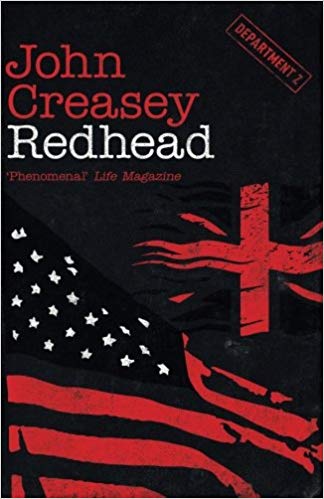
Redhead Creasey

Life Magazine are liars

I seem to recall saying something recently about having developed quite a tolerance for a new writer’s missteps if I think he has potential. There were a few lines about being a glutton for punishment too…… so, in that vein, let me talk a little about Kindle Unlimited.

I don’t trust any man who doesn’t read. Call it a prejudice, a bias, or whatever but when I hear people tell me they get all their information from YouTube or audio-books I’m immediately on guard. Writing is thinking, whereas speech is mostly rhetorical. You want to know the kind of people who ignore books and love speeches….. Jordan Peterson fans. Just look at the video.

https://www.youtube.com/watch?v=syI_B8a5IV4

Okay, I couldn’t find a video I liked of Peterson. As Vox Day very capably demonstrated in his dozen Darkstream takedowns of The Crazy Christ, Jordan Peterson fans are completely retarded. They literally don’t even read the man’s books. So Vox read both 12 Rules For Life and Maps Of Meaning and immediately figured out that Peterson is a charlatan, not at all well-read outside of his clinical psychology specialism [1], obscurantist, and mentally ill. As he’d say this on his live Darkstream, JBP’s idiot followers would come on and prove they hadn’t read him.

Why? Because JBP fans are the lowest of losers and can’t read. They soak up his tosh because they lack the clarity of mind and mental focus that is built by spending years of your life reading books. They are only half-evolved.

JBP is an extreme case. You get the same retarded behaviour with Joe Rogan fans, Richard Spencer fans, and of course our little world of pick-up has the same retards following YouTube game guys who spout obvious nonsense and the retards lap it up. RSD are the worst for that. It’s no coincidence that none of these guys are writing books [2]. If you want to make the most of your mind, you must read.

41Bsa0GNB5L

I’ll be reading this soon

However, you probably shouldn’t start with Kindle Unlimited. It is notorious for the tripe on there. I’m lucky, however, because two genres I really enjoy are well-served. First, there is the WW2 memoir [3] popularised by Sven Hassel. Ten years ago I finished the fourteenth (and last) of his books and I was distraught – there were no more new books to read. So I went looking into his contemporaneous knock-off writers like Heinz Konsalik, Leo Kessler, and Wolf Kruger. Now that I’m on Kindle Unlimited I see that there’s a burgeoning sub-genre in WW2 Nazi memoirs of questionable historical integrity [4]

The other genre is hardboiled detective fiction. In this case, the quality is far higher because wily publishers are re-releasing entire series of previously-published, and often popular, paperbacks from the golden age of that genre. Thus all the Perry Masons are on there, as are the thirty Ed Noon books [5]. So now I have access to almost unlimited free books in my two favourite genres. Score.

Sadly, most of the modern stuff of KU is absolute tosh. Just have a look at the dross in the Fantasy and Sci-Fi sections on KU. If any readers know new writers doing genuinely good Conan-style fantasy or space marine / bad-ass Sci-Fi then let me know. And, God forbid, if you were to peruse into the Romance sub-sections…… holy shit!….

51bDDuzpS6L

The kind of KU book I won’t be reading

One place KU has sadly disappointed me is with John Creasey, my favourite high-speed hack writer of detective fiction. I love his Inspector West and his The Toff tales. Those were written from about ten years into his career, when he’d already learned far more about his craft than any ponderous fiction writer will ever learn. None of those are on Kindle Unlimited [6]. Instead, the only Creasey on KU are his Department Z spy novels. All thirty of that long-running series are on there but…… two problems.

First, it was his very first series, written from his mid-twenties onward. That makes the books immature and badly written compared to his Inspector West stuff. If I want to read Creasey for free, I don’t get the best Creasey.

Second, I find it impossible to join a series mid-way through. I’m starting at the beginning or not at all. “But Nick, why not just start at book #20 when he’s a better writer?” No, that’s not how my mind works. I’d find it physically painful to know there were nineteen other books laying out the groundwork that I’d so carelessly skipped over. I’m thorough and I like to beat around the bushes before I assault the citadel.

So despite reading the hopelessly bad The Death Miser as #1 in the Department Z series I felt strangely compelled to go through the second, Redhead. Creasey had me entranced like a snake looking at a mongoose. Fortunately for me, the second book is a big step up from the first. It doesn’t get boring until halfway through. So, what’s it about?

It’s the 1930s and two cousins, both amateur boxing champs in England, are visiting NYC. Local newspapermen, #FakeNews, print a made-up interview with them where they appear to challenge the gangsters. Said gangsters waylay them on a country road and shoot up their car with tommyguns, but fail to injure them. The lads flee the US by boarding a steamer but, a little amped up at having to run, they pick a beef with a big strong youth on board. He’s a ginger. There’s a hot girl on board too, who gets herself into trouble.

What follows is lots of carefree derring-do as an American gang under the leadership of the shadowy ‘Redhead’ try to take control of a cache of loot hidden in the cellar of a country house defended by an English gang run by ‘Zoeman’. It’s all nonsense. The girl is kidnapped a couple of times and all the young men risk life and limb to rescue her even though she isn’t fucking any of them. It had make-it-up-as-you-go-along plotting and no-one ever does the sensible thing at any time. Many of the leaps in logic made by the main characters make no sense at all, betraying then-young Creasey’s immaturity.

For all that, even in this early book it was clear Creasey was a natural writer. For all its many flaws, it was readable. Most interesting to me was the originality of the tone. Remember this was written in 1933 so it was before James Bond. The set-up is very close to Ian Fleming‘s work, having a London-based ‘M’ character, a line of secret agents with numbered code-names, and then detective-style stories laced with murderous action as the agent tries to infiltrate, identify, and then take down a criminal mastermind at the head of an international organisation.

It’s all fantastical and doesn’t aim at the realism of a Mr Moto or Matt Helm story. The gangsters in Department Z stories all shoot with the accuracy of Empire stormtroopers.

The set-up has me intrigued as I know Creasy becomes good. The question is how quickly does he become good? Kindle Unlimited has set up an intriguing race against time in which Creasy’s free Department Z books need to improve quicker than my patience with them wears out.

Who will win? It’s like taking a laxative and an Immodium at the same time.

51HAFN56T9L._SY355_

I wish RSD would take some

If you’re like to read a prolific author who started out a bit shit and soon became fantastically good, you might like to check out my product page here. It’s the best daygame material money can buy and way better than the tripe on YouTube [7]

[1] That wouldn’t be a bad thing, except his books are basically philosophy and mythology so you have to be well-read outside of his speciality, otherwise you’re faking it. Peterson hasn’t read the Western canon.
[2] Did any of them write a book? I can’t recall one but perhaps readers can fill me in. They certainly are predominantly working through the medium of video and speech.
[3] Or pretend-memoir, really. I don’t trust these things.
[4] It’s always Nazi tank-men. Never infantry or Luftwaffe, and never Japs, Brits, Yanks, or Reds.
[5] More on them in a later review.
[6] The bastards!
[7] Except Street Attraction. Alright there, Eddie? 🙂

#92 – Devil, Devil, Michael Avallone BOOK REVIEW

November 2, 2018
krauserpua

Satan Sleuth 3 Devil Devil F012

If you choose books according to their covers…

I’m a pretty tolerant forgiving sort of person. Just the other day, Jimmy said to me, “Nick, you’re a pretty tolerant forgiving sort of person” [1]. There are few things in the world I’m as tolerant of as dopey adventure writers when I’m in the midst of a reading binge. It’s all about the abundance mentality and its ugly sister, the scarcity mentality.

Any good player knows about that. When you’re not getting laid, you can get thirsty for skirt. Sex is an appetite like any other, but unlike hunger or sleep it also carries a huge ego component that can make you crankier than an alley cat. Food doesn’t reject you when you’re jonesing for it, but women do. Thus falling into the ‘scarcity mentality’ – that you need a woman and any given lead is precious due to its scarcity – can quickly become a vicious circle of neediness begetting neediness.

Abundance mentality is the opposite, that once you’ve got lots of women in your life (or, more crucially, the optimism that the next set of women are just around the corner) you begin to behave differently. You can #WalkAway from neediness and dependence on skirt. The whole of your game tightens up, using roll-offs, terse messages, silences, and indifference like the four horsemen on the gaming apocalypse.

Game is Life and Life is Game.

Game of Life

No, not Game of Life, silly!

I find the same abundance/scarcity operates in respects to my free time. I sympathise with all you office-bound losers who are woken by alarms while it’s still dark outside, shuttle in to your worthless jobs on a train, then sit in a cubicle all day. When you finally clock out at 6pm you’ve got a tiny window of free time to get all your shit done. Frankly, I’m surprised you don’t just top yourselves. You have a scarcity mindset of for time. You need to prioritise. [2] Believe me, I’ve been there and I sympathise [3].

Something has to give. When I was in that situation I became very choosy over what I’d read. I might only read one book a month so if I’d read something as comically shit as The Satan Sleuth: Fallen Angel I’d have thought to myself, fucking hell I’m not wasting my time on Michael Avallone any more. It’s already a tough sell to read trashy paperbacks about The Punisher of satanists, so a single bad experience would turn me off.

I am, however, on a year-long reading binge. I have fucking tonnes of free time. Here’s my typical day:

  • Wake up at 10am, hit snooze three times, get up at 10:30 and out of the apartment a half hour later.
  • Sit in a big comfy wing-back chair in a cafe with my Kindle, sipping coffee and reading. Usually I’m fasting so I skip breakfast.
  • Hit the gym around 1pm, shower, then back out for lunch around 3pm. Usually my Kindle is with me and I’m reading again. That’ll take me until 5pm when I’ll go for an hour’s walk.

Evenings tend to be varied, depending who is in town, and whether I want to keep cracking on with the book, or writing a book of my own, or hurtling through the latest video game to take my fancy [4]. The point, however, is I have almost unlimited free time. I can read four hours a day without even beginning to prioritise. It’s made me a glutton for punishment regarding books.

I have such an abundance mentality regarding time – and thus reading – that I’ll try almost any type of book. I want to sweep up any novel that interests me even if I know it’s a bit shit. That’s why I kept plugging on with Michael Avallone. I thought to myself, who the hell would write a trilogy of trash like The Satan Sleuth? After ten minutes of google, I had my answer: he’s the American John Creasy and described himself as ‘the fastest pen in the West’. Legend has it he wrote one novel in only a day and a half!

Avallone

This is who

I’m glad I gave Avallone a second chance because he’s really grown on me. The second book The Satan Sleuth: The Werewolf Walks Tonight was decent. This third one Devil, Devil is also…. okay. I’ll tell you what I like about it.

You know how I have an abundance mentality for reading? Michael Avallone has it for writing. He was knocking out a book every week or two so he’d get a concept, run with it, and then move on to the next one. He clearly took pleasure in experimenting with genres and high concepts knowing full well if he made a mistake, he could just submit the manuscript and move on to the next challenge. Reading him is roughly analogous to talking to a man abundant in girls (or money, or fame, etc). He just doesn’t give a fuck. It blows through the prose like a refreshing sea breeze, a sense that he’s going to write whatever he wants and never second guess himself. His books hurtle forwards.

None of that ‘cross out a sentence and rewrite it until it’s perfect’ that dickheads like Dostoevsky or Shakespeare would do. Avallone gets shit done.

The story here is relevant to anyone who has followed #PizzaGate and the #SpiritCooking black masses and satanic rituals in NYC that seem to involve an awful lot of Left-wing celebrities and politicians. There’s a witch [5] living above Central Park who has cherry-picked a small group of satanists for her rituals, which include brutally murdering and decapitating young women. Cops think it’s a spree killer and are clueless (literally). So the Satan Sleuth comes in and quickly finds out the witch’s dayjob is at a high end fashion boutique. He attempts to infiltrate but things quickly go to shit.

Spirit Cooking

Sold his soul to the devil and still wasn’t granted talent or a hot wife

It’s schlock. Don’t get me wrong: when I say I enjoyed it, I’m not pretending it’s at the level of classics like The Three Musketeers or A Deplorable Cad.

What don’t I like about it? Rarely have I seen a book so thin in content. There are very few scenes, no sub-plots, and it moves in a predictable straight line. Even for a slim book, Avallone is noticeably padding it out with superfluous paragraphs and descriptions. It would’ve worked better at half the length. I get the feeling he realised half-way through that he’d never write another Satan Sleuth book so he began phoning it in. Overall, a fun quick read with a very silly story.

Speaking of silly stories, why not check out my memoir series or even treat yourself to a big chunky packed-with-value textbook on how to pick up girls (though not how to decapitate them and leave the body parts in dusty cellars). See my product page here.

[1] I may have made that up, as an excuse to begin this review on a particular topic.
[2] So keeping up to date on rambling reviews of low-quality novels probably isn’t high on the list.
[3] Not really, but I like to at least pretend.
[4] Right now, that’s Valkyria Chronciles. Awesome.
[5] Had it been written now rather than in 1973, I’m sure she’d have looked like Marina Abramovich