#84 – The Case Of The Howling Dog, Erle Stanley Gardner BOOK REVIEW

October 6, 2018
krauserpua

Howlling Dog

Fans of Sherlock Holmes [1] are well aware of the dog that didn’t bark. It comes in The Adventure Of The Silver Blaze, in which a rapscallion stable-lad tries to nobble a race horse before a big event only for the horse to kick him in the face, killing him deader than Hillary [2]. Nobody knows this at first, thinking the lad was attacked by a man, so there’s a manhunt on and Sherlock Holmes is called in. There’s a key exchange treasured by all us fans in which Holmes explains to us the fact the stable-dog didn’t bark during the night of the attack was the key fact. It meant the murderer was known to the dog, and thus likely part of the household.

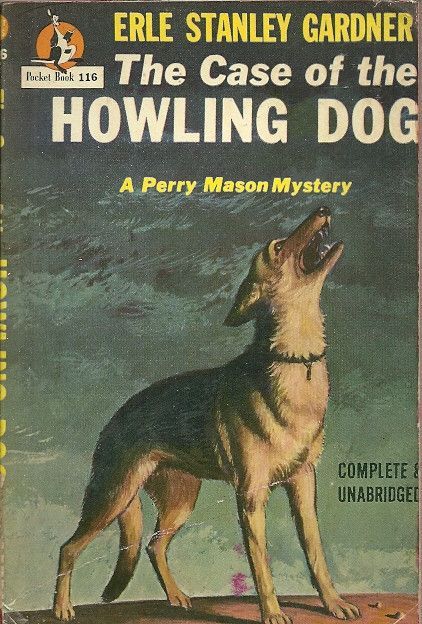
Erle Stanley Gardner has written this entire book, The Case Of The Howling Dog, in homage to that exercise in deductive logic. It starts simply enough. An agitated millionaire, Arthur Cartwright, comes into Perry Mason’s office wishing to make a will giving away everything to the wife of the millionaire living next door to him, Clinton Foley, even though he hates him. He swears that Foley has taught his police dog pet to howl in order to drive Cartwright mad. The dog had begun howling the previous night.

I won’t spoil the story. It’s a really good mystery. It’s enough to say that whether the dog howled (or not) is the crux of the matter.

Case Of The Howling Dog

There’s both a 1934 movie, and a more recent TV adaptation

The reason Perry Mason is such a good character is how he breaks the usual hard-boiled mode. Make no bones about it, he is of that genre. He isn’t solving locked-room puzzles like Hercule Poirot nor is he a cop chasing down serial killers like Alex Cross. Mason’s role in these stories is equivalent to a private eye at odds with the cops, only he’s a defence attorney in fact (if not in style). Whereas a Continental Op or a Philip Marlowe will play fast and loose with the law, Mason does not. It adds a crispness to his manoeuvres.

For example, Mason has his private eye helper Paul Drake put two men on stakeout at Clinton Foley’s house as he expects something fishy to happen. Turns out there’s a murder and Mason discovers the body when showing up for an pre-arranged appointment. So, there’s the question of what Mason should do.

  • Call the police immediately?
  • Have a look around the murder scene first?
  • Slip away and pretend he was never there?
  • Confer with the two stakeout men on his man’s team?
  • Blur the victim’s face and claim it as a Same Day Lay on YouTube?

I’m not sure what Philip Marlowe would do [3] but I’m guessing it would involve breaking the law to cut a break for his client. Mason think a minute then calls Paul Drake to have his two men return to the office and go into hiding. He checks the scene but doesn’t tamper with it at all, then after summoning the police he confers with Drake and the men.

Does he discuss it with them? You’d expect so but no he does not. He pumps them for factual information (who came to the house, when, in what taxi etc) and very pointedly does not share any of his thoughts with them and shuts them down when they attempt to pontificate. You see, Mason is thinking like a trial lawyer not a private detective. He knows he’s under no legal obligation to let the cops (and eventually prosecution) know his men were witnesses, and because he doesn’t tell either men any of what he found inside the house, the men don’t even know there was a crime committed to which they could be witnesses (he doesn’t mention the dead body). Additionally, in the unlikely event the men are found and testify under oath they can tell the absolute truth without incriminating themselves, Mason, or his client.

It’s rather clever how he operates, and a delight to read.

Regular readers are aware I’m trying to become a good writer [4] and what fascinates me most about Erle Stanley Gardner is the quality of his plotting. It’s oh-so-tight, fantastically complicated, and yet Gardner never gets his threads tangled. His prose is whip-sharp and there’s no messing around. Every chapter advances the story and he never needs a sleight of hand to get out of trouble. I read it and think, “I could never invent a plot that good”.

Fortunately, I don’t need to. The thing about memoirs is that life provides the plot. For now I can polish my skills in prose, dialogue, characterisation, action, scene-setting, pacing and all those other elements of writing. If I ever get good at that stuff, I’ll look towards plotting and fiction.

Murder She Wrote

Do not – under ANY circumstances – cultivate an acquaintance with this woman.

One other observation concerns the hard-boiled genre in general. You know those Murder, She Wrote TV shows featuring Angela Lansbury? No matter where she goes – a cruise, a ski slope, a village fete – you can guarantee someone is getting murdered. She’s a murder magnet and frankly if I ever crossed paths with her I’d run as fast as possible in the opposite direction. Well, I’ve noticed that in hard-boiled fiction that if you walk into a private eye’s office and start telling lies, you’re fucked. Someone is gonna bump you off. It’s an even more certain route to death than having sex in a horror movie or being close to retirement in a cop movie.

I absolutely recommend this book. Erle Stanley Gardner is always good and this is one of his best.

If you live in the USA and would like a cheap, no-fuss way of buying my books in full colour you should have a look at my new sales site here. Sadly, the company cannot yet fulfil orders sent outside the USA. For that, consult my usual products page.

[1] The original stories, and perhaps the 1980s TV adaptation starring Jeremy Brett. Not fans of the gay soyboy global-homo version starring Benedict Clusterfluck and the hobbit.
[2] I expect people to read this post two years from now, so I’m future-proofing it.
[3] I bet you know which Deepak would do from that list.
[4] You could claim I’m more writer than player nowadays.
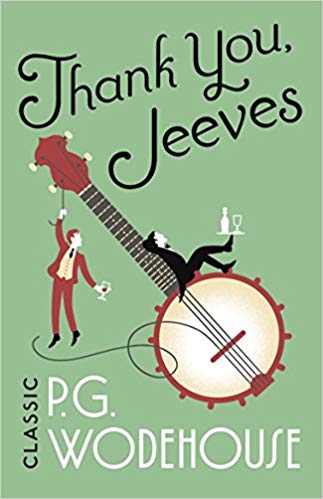
#83 – Thank You Jeeves, P.G. Wodehouse BOOK REVIEW

October 3, 2018
krauserpua

Thank You Jeeves

I’ve been watching more of the Masterclass video seminar series of late, with a focus on the writing courses. The first, Aaron Sorkin’s, was really good and then David Mamet’s was helpful too. They were all about screenwriting but now I’ve finished James Patterson’s on how to write popular genre fiction. He’s the guy who did all the Alex Cross detective stories that have since become terrible movies. What all three writers had in common was their advice:

Raise the stakes.

All drama involves intention-plus-obstacle, meaning the protagonist has something he needs/wants and drama ensues when he encounters and attempts to overcome the barriers in his way. This is the engine driving the plot [1]. However, the intention cannot be “I want a Mars Bar from the local Paki shop” and the obstacle can’t be “but a dropped my last pound coin down the toilet.” Sure, there is some drama here – do you put your hand into the bowl of piss to grab the coin, or do you flush first and risk the water sweeping the pound coin away for ever – but the stakes are not high.

What’s the worst that could happen?

So, you’re supposed to raise the stakes. Perhaps the Mars Bar purchase is just a feint and actually you’re part of the English Defence League and the Pakistani store owner may be the only link to a shadowy underage grooming gang who has kidnapped Tommy Robinson’s daughter [2]. The stakes are now much higher and the story should be more compelling. What if you can’t fish that pound coin out of the toilet and you need to find a different way into the shopkeeper’s confidence? Perhaps you decide to confront him directly.

What’s the worst that could happen? Well, you could be called racist. The stakes don’t come any higher than that, do they?

Anyway, I digress. The point is that it’s standard practice in modern genre fiction to raise the stakes. If there’s spies, you can bet there’s a nuclear bomb about to go off. If it’s detectives, the crime will be murder rather than loitering. If it’s soldiers, it’s war rather than a drinking competition in a Berlin bar. This is why P.G. Wodehouse’s famous Jeeves & Wooster series is quaintly charming – the stakes are always very low.

In the case of the first Jeeves novel, Thank You Jeeves [3], it’s all about whether his buddy Chuffy can successfully propose to an American girl without getting a reputation for being awfully forward. Those are the stakes. It takes some polished writing chops to form a compelling novel from that, what?

Wodehouse achieves this primarily through farce. The book is narrated by Bertie Wooster himself, a dim-witted but soft-hearted young aristocrat who pompously clings to etiquette and Eton-style relationships but isn’t above bending the rules to help a chum. Wodehouse builds his character subtly through Wooster’s odd choices of metaphor, frequent lapses into digression, and his inner monologue identifying what he finds important in any situation. His efforts to aid his friend Chuffy always makes things worse, and his efficient butler Jeeves operates in the background – not unlike a benign Mr Moto – to straighten things out and prevent disaster.

fry_Laurie_2223235b

Pretty good TV adaptation

It’s a lot of fun and it’s easy to become embroiled in the silly concerns of the young aristocrat, such as when he blacks up like a negro minstrel to effect escape from a yacht but can’t find the butter needed to wipe off the shoe polish and thus must hide from the local village police who are beating the bushes for him. The dialogue is also great, amply describing the relationship between aristocrat and butler without needing to spell it out. Consider this, the very first conversation in chapter one:

‘Jeeves,” I said, “do you know what?”
“No, sir.”
“Do you know whom I saw last night?”
“No, sir.”
“J. Washburn Stoker and his daughter, Pauline.”
“Indeed, sir?”
“They must be over here.”
“It would seem so, sir.”
“Awkward, what?”
“I can conceive that after what occured in New York it might be distressing for you to encounter Miss Stoker, sir. But I fancy the contingency need scarcely arise.”

Also funny is how Wodehouse has Wooster describe his new butler Brinkley. Early in the book Jeeves resigns because he cannot bear Wooster’s new habit of playing the banjolele and thus the latter has the agency send a new man, who turns out to be a Leftist [4]. Wodehouse peppers the book with cheerful references to the man’s class-opposition to Wooster and how the latter doesn’t grasp how serious a revolution may be.

Like a sheep wandering back to the fold, this blighted Bolshevik had rolled home, twenty-four hours later, plainly stewed to the gills. All the householder awoke in me. I forgot that it was injudicious of me to allow myself to be seen [he’s still blacked up]. All I could think of was that this bally Fiver-Year-Planner was smashing up the Wooster home.

Or earlier in the book:

Outwardly he was all respectfulness, but inwardly you could see that he was a man who was musing on the coming Social Revolution and looked on Bertram as a tyrant and oppressor.
‘Yes, Brinkley, I shall dine out.’
He said nothing, merely looking at me as if he were measuring me for my lamp-post.

Wooster wasn’t to be knocked from his peace of mind by a blighted Marxist so he persists in giving his instructions to his butler.

He sighed slightly. All this talk of my going to shows was distressing him. What he really wanted was to see me sprinting down Park Lane with the mob after me with dripping knives.
‘I shall take the car and drive over there. You can have the evening off.’
‘Very good, sir,’ he moaned.
I gave it up. The man annoyed me. I hadn’t the slightest objection to his spending his time planning massacres for the bourgeoisie, but I was dashed if I could see why he couldn’t do it with a bright and cheerful smile. Dismissing him with a gesture, I went round to the garage and got the car out.

I will say that with such low stakes powering the drama this book got a little boring at times, hence I can see what Sorkin, Mamet, and Patterson were getting at. Shifting to accommodate this reduced urgency in plotting, I figured the best way to read a book such as Thank You, Jeeves is to read it on a sunny day, sitting in a chair overlooking a pleasant park, and with a tequila sunrise cocktail by the side. Which is what I did.

garden

One seeks a little solace from the blasted proles, what?

If you’d like to read books about a dim-witted hero and his competent man-servant you may enjoy the interplay between Nick Krauser and Jimmy Jambone in my series of memoirs available here (USA readers) and here (everyone else).

[1] And why Leo Tolstoy’s War And Peace is so bloody boring. There’s no intention-plus-obstacle. It just meanders along.
[2] Does he have a daughter?
[3] Thank You Mr Moto does indeed deal with war and murder. A different world.
[4] In the pre-War sense of supporting trades unions, socialism and Marx, as opposed to the modern sense of being a mentally-ill transexual liar.

#82 – Your Turn Mr Moto, John P Marquand BOOK REVIEW

October 3, 2018
krauserpua

Mr Moto

James Bond before James Bond. Doesn’t that sound like a good book? Well, sonny Jim, if you’ve already been following my reviews of Dennis Wheatley you’ll be aware he had a lock on the whole dashing English secret agent racket long before Ian Flemming‘s golden eye turned towards the genre. But what about if the secret agent wasn’t on our side? What if he was an adversary, seen only from the outside? That’s what we’ve got with the dastardly Japanese agent Mr Moto. Actually, I’ve been a bit unfair. He’s actually a rather honorable man, this Jap. I’m very, very sorry, Mr Moto. I do hope we can be friends, yes?

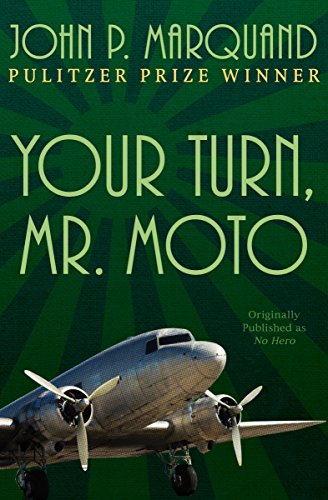
Your Turn, Mr. Moto is the first of the long-running series and you can tell that John P Marquand wasn’t necessarily banking on it ever getting that far, based on the original title: No Hero. That refers not to Mr Moto but to the narrator, one Kenneth C. Lee – K.C. – who is a washed up former flying ace kicking his heels in Tokyo, drinking the bar dry at the Imperial Hotel [1], until he can begin a trans-Pacific flight sponsored by a tobacco company. The company welshes on him and in a fit of dejected anger, poor Casey decides he’s through with America and wants everyone at the bar to know it.

That attracts the attention of Mr Moto, who makes an approach. Casey is hired to take a ship to Shanghai and ascertain if his old buddy Commander James Driscoll has possession of a missing blueprint. Thus is set up a tale of international intrigue as the US, China, Japan and Russia all attempt to locate and take possession of a secret formula to double the efficiency of gasoline, and thus redraw the world’s spheres of influence based upon battleship / cruiser’s patrol range.

Mr Moto movie

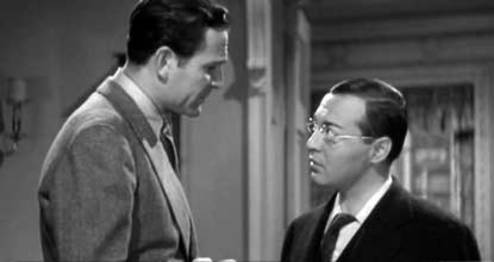
“So very sorry, Mr Moto”

Aside from being a damn good book, this one interested me because it’s written in 1935 and thus four years after Japan’s invasion of Manchuria and six years before Pearl Harbor. Marquand makes it clear what the international tensions are. Japan is a crowded island with few natural resources, and an eye on expansion into China. The US Admiralty worries whether Japan will attack Hawaii, which the USA had only invaded forty years earlier and still hadn’t entirely consolidated. Stuck out in the middle of the Pacific, Hawaii was a permanent aircraft carrier and necessary hopping-off point should Japan wish to attack East, or the US do so to the West. Naturally, we now know how that turned out.

Few things are a surprise in world affairs, so it’s nice to see Marquand lay out the geo-political tensions and history has only confirmed the conjectures he makes. There are also frequent references to the Tokyo 1923 earthquake and the Japanese attempts to experiment with quake-resistant concrete structures. In the meantime all major Japanese cities are tightly-packed wooden structures that everyone knows damn well are vulnerable to firebombs [2] and thus Japan isn’t happy about China’s growing air force. It sets the scene plausibly for why the missing blueprint is so vital.

721975-tokyo-5

How vulnerable? This vulnerable

The narration begins with Casey’s last push into nihilism and rootless cosmopolitanism [3] with the fall-through of the trans-Pacific flight he was banking on for redemption. After agreeing to turn traitor, he has second thoughts and Mr Moto attempts to have him assassinated during his passage to China (he’s so very, very sorry about that, you understand). Casey rediscovers his Americanism, goes full-MAGA, and then foils the plans of both China and Japan. It’s nicely done.

I enjoyed how Marquand painted 1930s Tokyo because, while not living there myself until 70 years later, it felt just how I’d pictured it – a hybrid between old-Edo and new European fashion. Shanghai is presented as a bustling seething mass of ant-like people and not unlike the Chinatowns of Fu Manchu stories. Unlike a James Bond story, Casey is a rank amateur relying on gut instinct and unaware how many pros are protecting him behind the scenes. Mr Moto himself is a savvy agent and a strict professional and the concluding scenes make clear he hold no enmity to the agents in rival powers.

I’ve read four Mr Moto books now and can absolutely recommend them. They’ll especially appeal to ex-pats in Asia who have suffered bouts of anomie and the pull of globalism.

If you’re a proud American and also like skirt, check out my new Sigma Wolf bookshop where you can buy full colour editions of all my books, in both soft or hardcover, without having to fuck around with sending me PayPal payments. Sadly, the site cannot yet sell to territories outside the USA.

697200869-612x612

Looking forward to reading this entry in the series.

[1] Something I once did on a business trip in my pre-game life, as it happens. A lovely hotel.
[2] The USA would confirm this in the 1945 firebombing of Tokyo that killed vastly more civilians than the two atomic bombs did.
[3] Don’t worry, he’s not a Jew.